
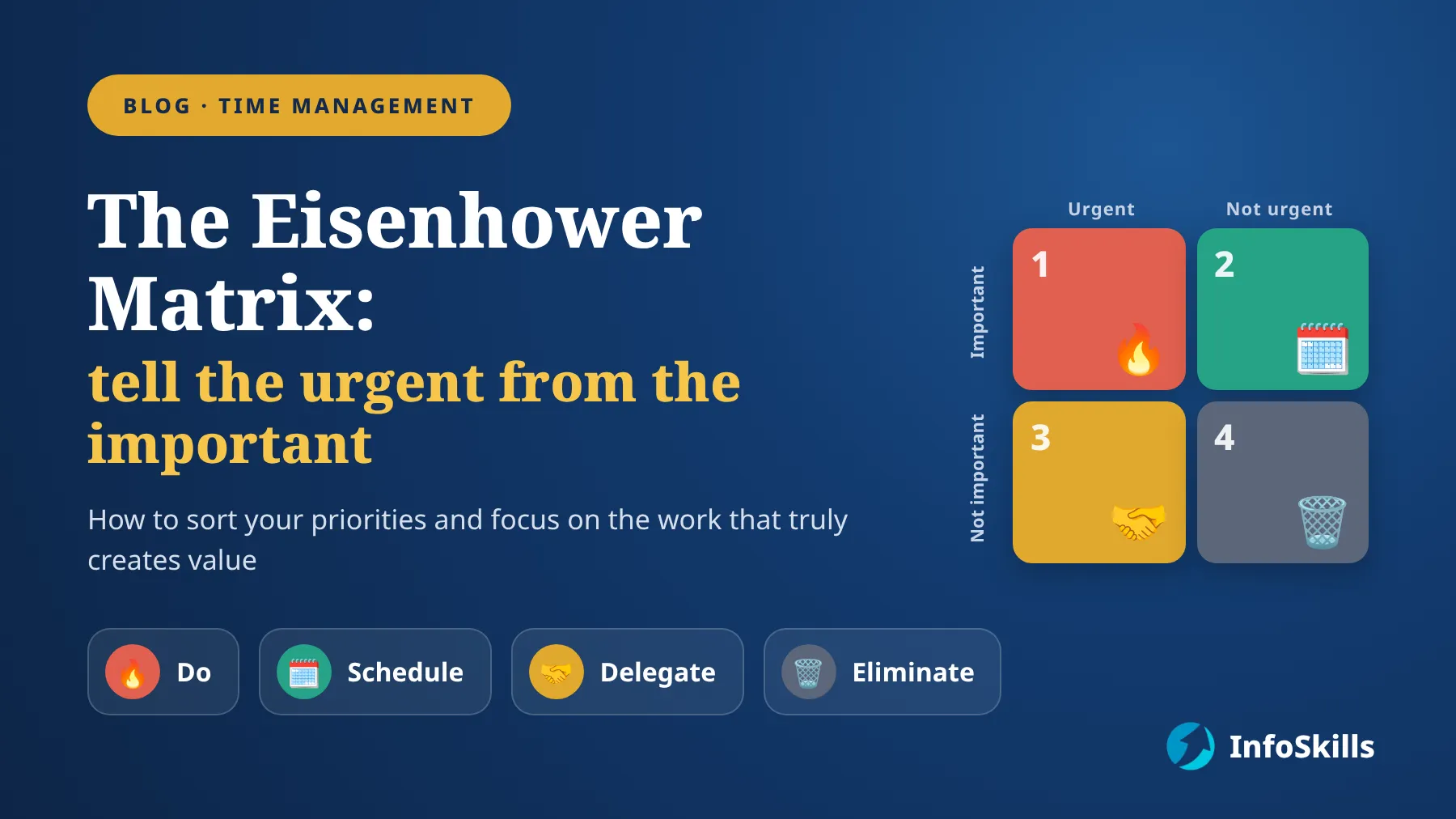
The Eisenhower Matrix: how to tell the urgent from the important
We were busy all day, yet the important task was pushed to tomorrow again. We look at the Eisenhower (Urgent–Important) Matrix: its real history, the four quadrants, the science behind it, an example and a practical cheat sheet.


It’s 6 p.m. You answered 40 emails, attended three meetings, solved a “burning” problem for a colleague and replied to every message within five minutes. You were busy all day. And yet the strategy document you have been planning to write for a month is still untouched. Again.
The problem is not laziness or a lack of time. The problem is that urgent things shout, while important things wait quietly. And we usually listen to whoever is louder.
One of the simplest and best-known tools for this problem is the Eisenhower Matrix, also called the Urgent–Important Matrix. In this article we look at where it really came from, how its four quadrants work, what research says about the “urgency trap”, and how to apply the matrix starting today.
What is the Eisenhower Matrix?
In one sentence: the Eisenhower Matrix helps you manage your time by separating urgent tasks from important ones and focusing on the work that truly creates value.
Its central idea is simple: set your priorities correctly.
In plain language, the matrix helps you decide:
- 👉 what to work on right now,
- 👉 what to schedule,
- 👉 what to delegate,
- 👉 and what not to do at all.
Two questions are enough to place any task: Is it important? (Does it bring me closer to my goals and values?) Is it urgent? (Does it require action right now, or soon?)
Where the idea came from: Eisenhower, a “former college president” and Covey
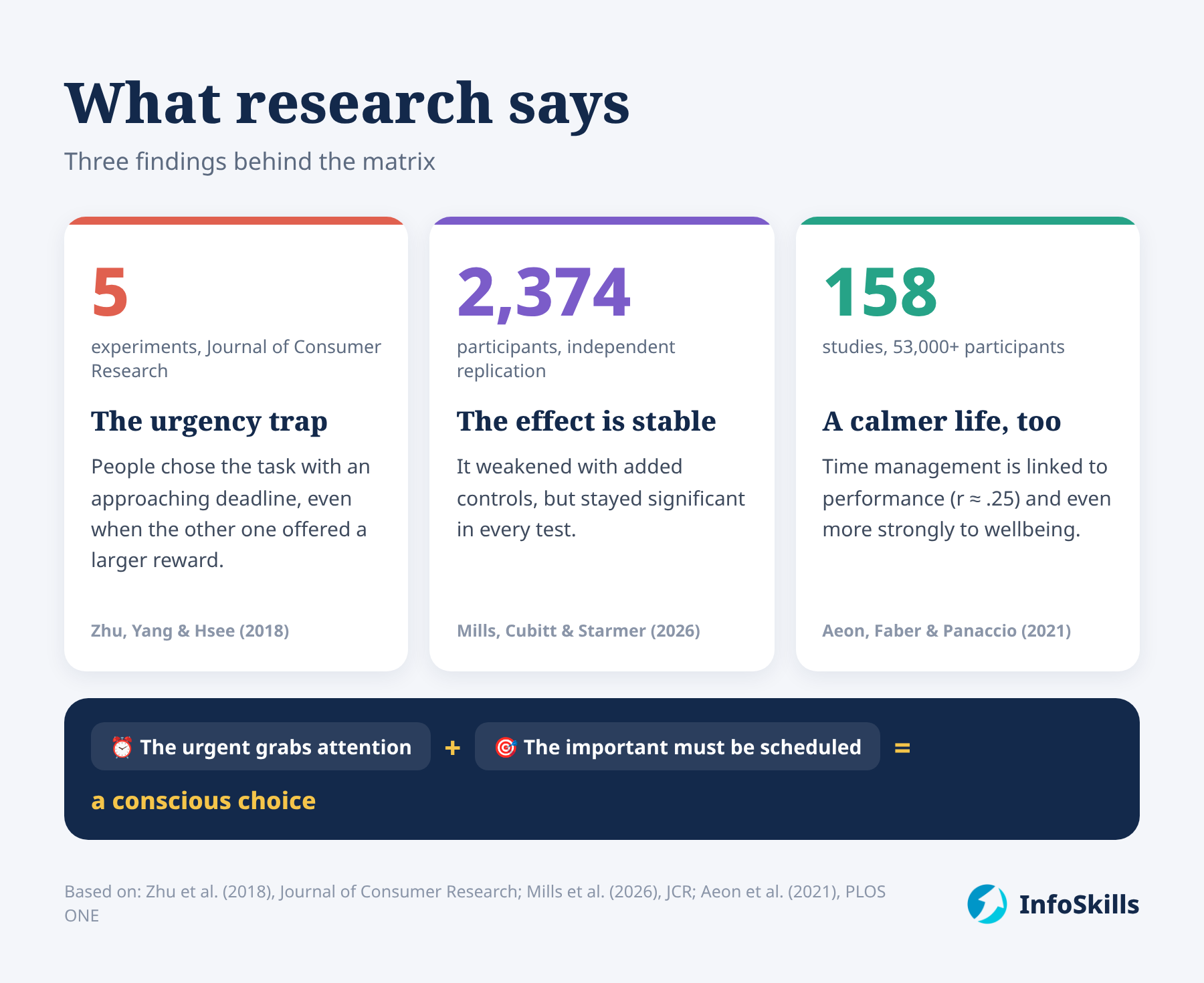
The idea is usually traced back to the 34th President of the United States, Dwight D. Eisenhower. On 19 August 1954, speaking to the Second Assembly of the World Council of Churches in Evanston, Illinois, he said [1]:
“I have two kinds of problems, the urgent and the important. The urgent are not important, and the important are never urgent.”
An important detail that is often forgotten: Eisenhower presented these words as a quotation from “a former college president”, without naming him [1][2]. The researchers at Quote Investigator, who traced the history of the saying, confirm that Eisenhower used it in 1954 but attributed it to someone else [2]. The popular version, “What is important is seldom urgent and what is urgent is seldom important”, is a later, smoother paraphrase of the same idea [2].
It is also worth knowing that Eisenhower did not draw the matrix himself. The two-by-two grid was made famous by Stephen Covey in his 1989 book The 7 Habits of Highly Effective People, where it is called the Time Management Matrix and is the core of Habit 3, “Put First Things First” [3]. Covey developed it further in First Things First (1994), written with A. Roger Merrill and Rebecca R. Merrill [4]. The name “Eisenhower Matrix” honours the person whose words inspired the idea.
The 4 quadrants of the matrix
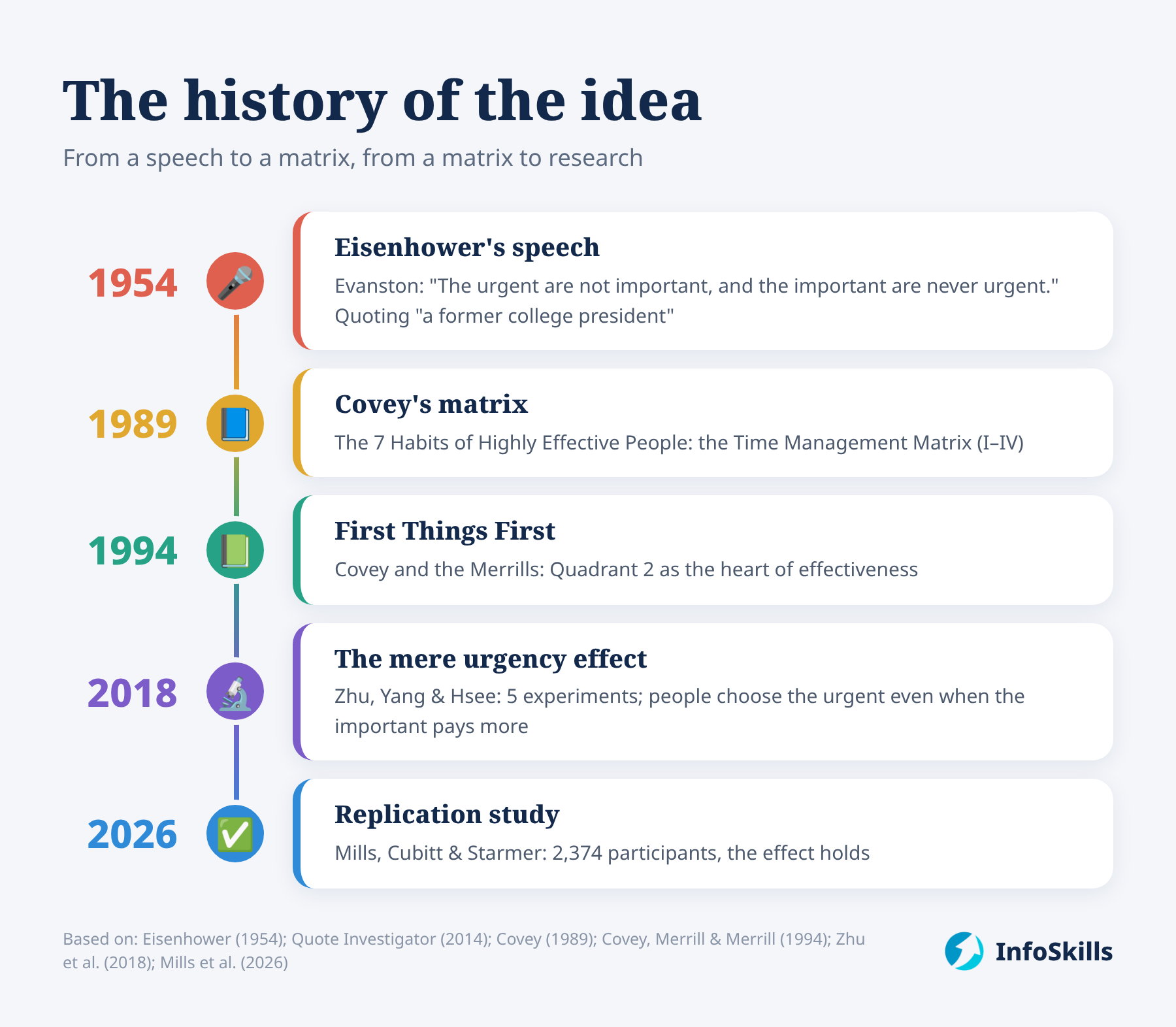
The matrix crosses two questions, important or not and urgent or not, and creates four quadrants. Covey numbered them I to IV [3]; the popular one-word actions (do, schedule, delegate, eliminate) were added later as a practical shorthand.
🟥 Quadrant 1. Urgent and important → Do it now
Crises, deadlines, problems that cannot be postponed: a key client’s complaint, a report due today, a broken system.
This quadrant cannot be avoided, but if you live in it permanently, it leads to stress and burnout. Many Quadrant 1 crises were once Quadrant 2 tasks that were never scheduled.
🟩 Quadrant 2. Important but not urgent → Schedule it
Strategic thinking, planning, learning and development, building relationships, prevention, health [3].
✅ This is the most valuable quadrant for long-term success. Covey called it the heart of effective personal management [3]. The trap is that nothing here has a deadline, so it is always easy to postpone “until tomorrow”.
🟨 Quadrant 3. Urgent but not important → Delegate it
Urgent requests created by others, some calls, some emails, some meetings [3]. They feel important simply because they are urgent and someone is waiting.
Here the question to ask is: “Does this really have to be me?” If not, delegate it, batch it, or politely say “no”.
⬛ Quadrant 4. Neither urgent nor important → Eliminate or limit it
Time-wasters, busywork, endless scrolling, unproductive activities [3].
This doesn’t mean you should never rest. Real rest and recovery are part of Quadrant 2. Quadrant 4 is the time that neither restores you nor moves you forward.
Why we fall into the urgency trap: what research says
Why is it so hard to choose the important over the urgent, even when we know it is better? Researchers have studied this question directly.
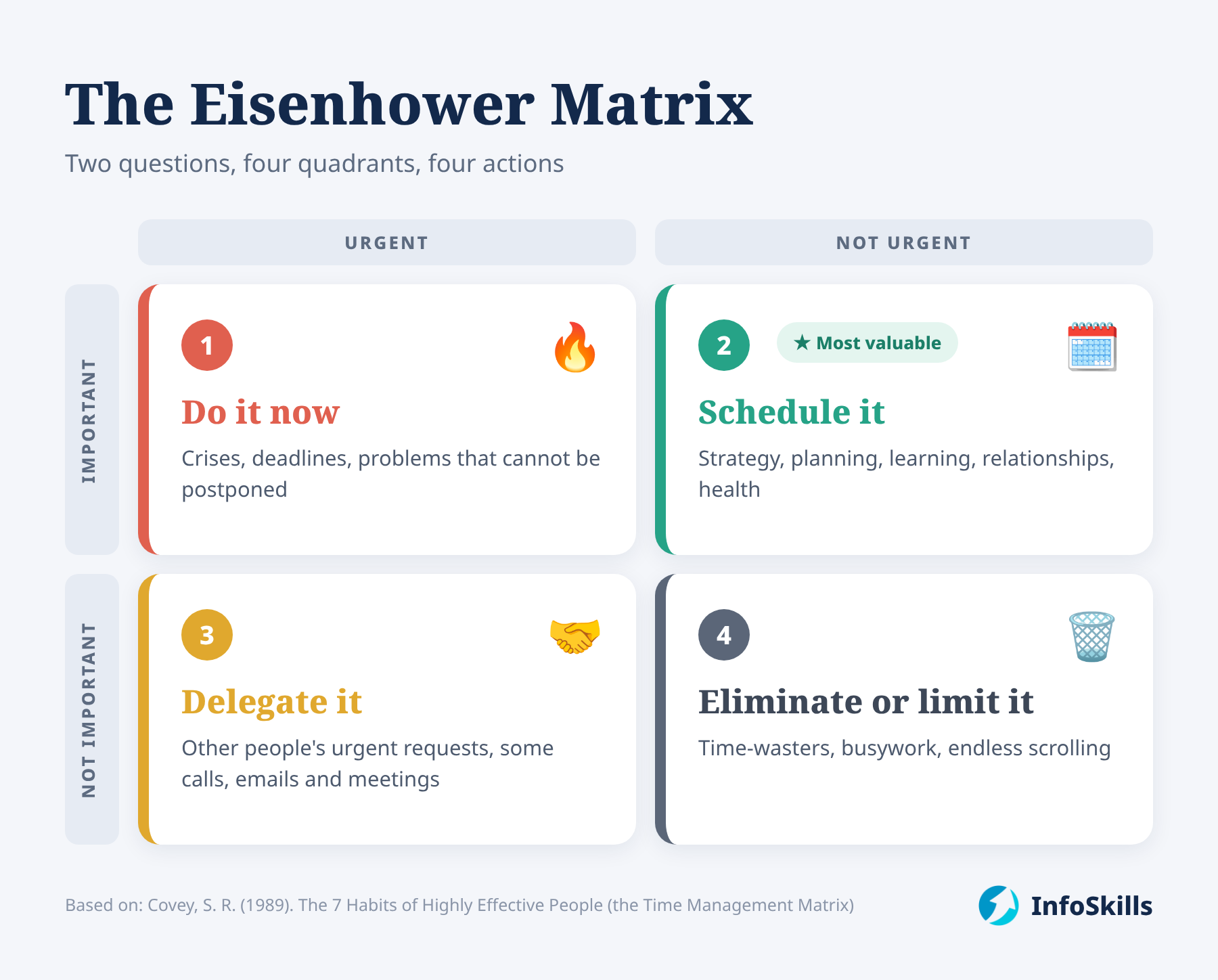
1. The “mere urgency effect”. Meng Zhu, Yang Yang and Christopher Hsee ran a series of five experiments [5]. Participants chose between tasks that differed only in their deadline and their reward. Many chose the task with an approaching deadline, even when the other task offered a larger reward and doing it was objectively better [5]. Urgency attracts attention to the short time window and pushes the size of the outcome out of view. The effect weakened when people’s attention was drawn to the outcomes, and it was stronger among those who saw themselves as very busy [5].
2. The effect holds up in replication. In 2026, Richard Mills, Robin Cubitt and Chris Starmer published a large independent replication with 2,374 participants [6]. The effect became weaker when additional controls were introduced, but it remained statistically significant in every test [6]. In other words, the urgency trap is not a myth: it is a real and stable tendency in how we make decisions.
3. Time management really does help, and not only with productivity. A meta-analysis by Brad Aeon, Aïda Faber and Alexandra Panaccio brought together 158 studies with more than 53,000 participants [7]. Time management was moderately related to job performance (a correlation of about .25), but even more strongly related to wellbeing: life satisfaction and lower distress [7]. Managing priorities is not only about doing more; it is also about living more calmly.
What this model develops
- ✅ effective time management,
- ✅ setting priorities,
- ✅ decision-making,
- ✅ focus,
- ✅ stress reduction,
- ✅ strategic thinking,
- ✅ self-discipline.
Why it matters
- It is simple and quick to apply: all you need is a sheet of paper divided into four.
- It works at both the personal and the organizational level.
- It helps you escape the “permanent rush mode” and the urgency trap.
- It focuses attention on long-term value.
- It is closely connected with effective leadership: a leader who lives only in Quadrant 1 teaches the whole team to live in crisis mode.
📌 Best suited for: managers and busy professionals, as well as anyone whose day is filled with requests from other people.
A simple example
If you spend the whole day only on urgent emails (Quadrant 3), you are not moving towards your strategic goals (Quadrant 2).
And real growth happens precisely in the second quadrant.
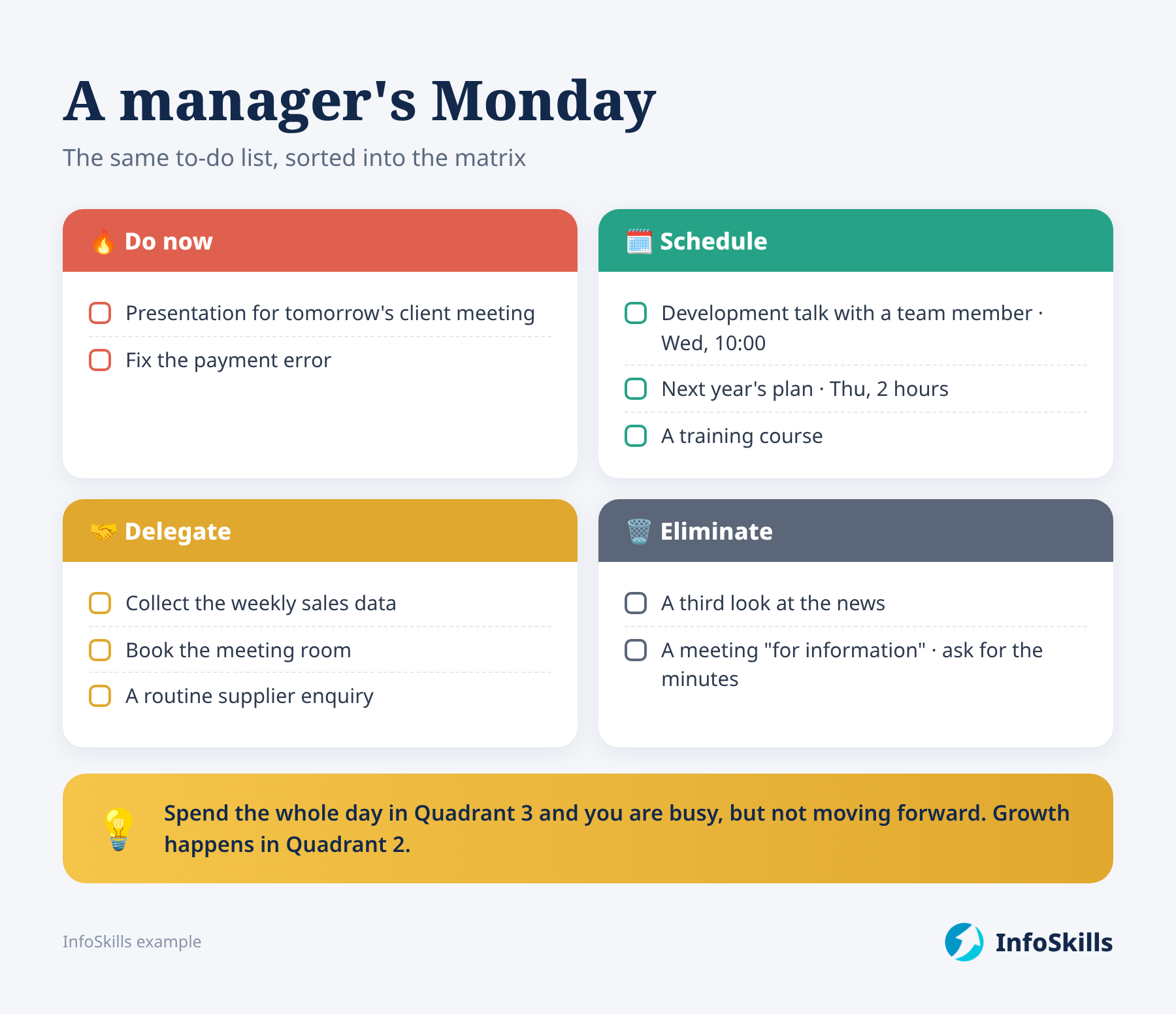
Here is how one manager’s Monday to-do list might look once it is sorted into the matrix:
- 🟥 Do now: prepare the presentation for tomorrow’s client meeting; fix the payment error.
- 🟩 Schedule: a development conversation with a team member (Wednesday, 10:00); work on next year’s plan (Thursday, 2 hours); a training course.
- 🟨 Delegate: collect the weekly sales data; book the meeting room; answer a routine supplier enquiry.
- ⬛ Eliminate: a third look at the news; a meeting where you are only “for information” (ask for the minutes instead).
How to apply it: 5 steps
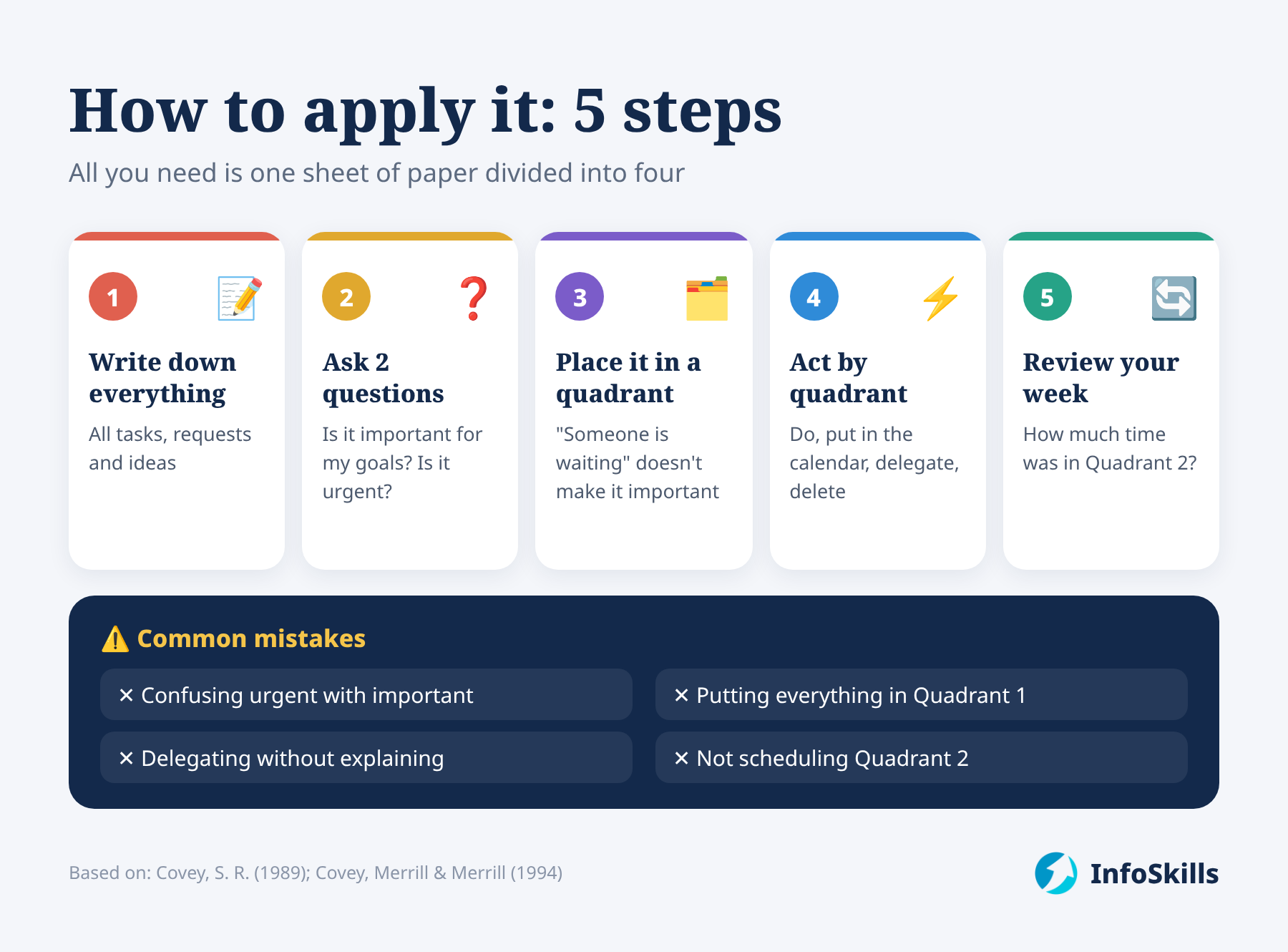
- Write down everything. All the tasks, requests and ideas currently in your head.
- Ask two questions about each task. Is it important for my goals? Does it have to be done now?
- Place it in one of the four quadrants. Be honest: “someone is waiting” doesn’t make a task important.
- Act according to the quadrant. Do Quadrant 1 tasks, put Quadrant 2 tasks in your calendar with a specific day and time, delegate Quadrant 3 tasks, and cross out Quadrant 4.
- Review it every week. Ask: “How much time did I spend in Quadrant 2 this week?” Protect at least one block of Quadrant 2 time in advance, and treat it like a meeting with an important client.
Common mistakes
- Confusing urgent with important. Someone else’s urgency is not automatically your priority.
- Putting everything in Quadrant 1. If everything is “urgent and important”, the matrix doesn’t work. Usually only a few tasks really belong there.
- Delegating without explaining. Delegation means handing over the task together with the context, the expected result and the deadline.
- Not scheduling Quadrant 2. “I’ll do it when I have time” means “never”. An important task without a time in the calendar remains a wish.
In summary
Effective people don’t just react quickly to urgent matters. They consciously choose to focus on what is important.
Fewer crises, more Quadrant 2 = growth.
Learn and practise with InfoSkills
The Eisenhower Matrix is one of the most practical tools for setting priorities, but it works best together with other skills: planning, focus, delegation and the ability to say “no”.
By taking part in the InfoSkills “Time Management” course, you will learn and apply not only this tool, but other effective tools and methods as well, which will help you set clear priorities, stay focused and get important things done on time.
In the course, every topic is reinforced through practical exercises, real-life situations and group work, so that knowledge becomes skill. And at the end, every participant leaves with a personal development and action plan.
Sources
- Eisenhower, D. D. (1954, August 19). Address at the Second Assembly of the World Council of Churches, Evanston, Illinois. The American Presidency Project, UC Santa Barbara. presidency.ucsb.edu
- O’Toole, G. (2014, May 9). What Is Important Is Seldom Urgent and What Is Urgent Is Seldom Important. Quote Investigator. quoteinvestigator.com
- Covey, S. R. (1989). The 7 Habits of Highly Effective People. New York: Free Press (Habit 3: Put First Things First). franklincovey.com
- Covey, S. R., Merrill, A. R., & Merrill, R. R. (1994). First Things First. New York: Simon & Schuster. en.wikipedia.org
- Zhu, M., Yang, Y., & Hsee, C. K. (2018). The mere urgency effect. Journal of Consumer Research, 45(3), 673–690. doi.org
- Mills, R., Cubitt, R., & Starmer, C. (2026). Brief commentary: An independent replication study of the mere urgency effect. Journal of Consumer Research, advance article. doi.org
- Aeon, B., Faber, A., & Panaccio, A. (2021). Does time management work? A meta-analysis. PLOS ONE, 16(1), e0245066. doi.org
Course: Time Management
© 2026 InfoSkills, Varuzhan Avanesyan. Reuse only with the author's permission and a link to the source.


















No comments yet. Be the first.