
Emotional intelligence: why “life smarts” can matter more than IQ
Why success comes not only to the smartest people, but to those who understand themselves and others. Daniel Goleman's emotional intelligence model: 5 components, the science behind them, diagrams and a daily practice cheat sheet.


Picture two people. The first is a brilliant specialist who knows every number and formula, but one careless remark in a meeting makes them flare up, interrupt colleagues, and then lose focus for the rest of the day. The second may not be such a “star student”, but notices the tension building, pauses, listens to the other person and finds a solution that works for everyone.
Which of them is more likely to become the team leader, the one people trust and want to work with?
Most of us know the answer intuitively. Psychology calls this difference emotional intelligence, and the American psychologist Daniel Goleman turned it into one of the best-known and most widely applied ideas in the world. In this article we look at what emotional intelligence is, where it came from, what it is made of, and how you can develop it every day.
What is emotional intelligence?
Emotional intelligence is a person’s ability to understand and manage their own emotions and to respond well to the emotions of others.
Goleman’s core idea is simple but powerful: success in life depends not only on intellect (IQ), but on how well we understand ourselves and other people [1]. You can be very clever, but if you can’t hold back your anger, listen to others or work in a team, success will be hard to come by. Emotional intelligence is exactly that kind of “life smarts”.
How the idea was born
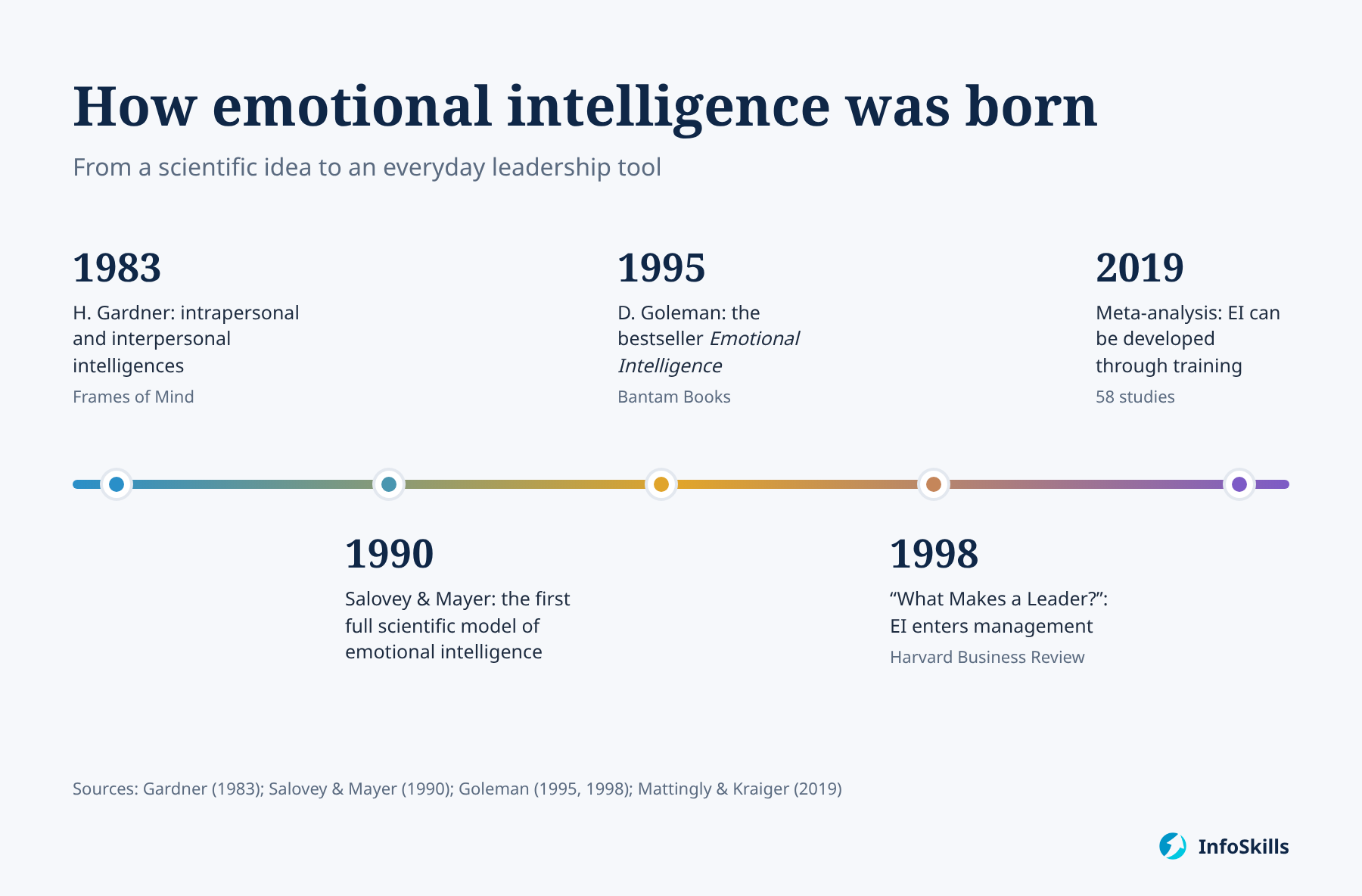
Emotional intelligence did not start with a single book. In 1983 the American psychologist Howard Gardner argued in Frames of Mind that there is more than one kind of intelligence, and singled out intrapersonal (understanding yourself) and interpersonal (understanding others) intelligence [2]. The phrase “emotional intelligence” had appeared as early as the 1960s [9], but the first full scientific model was set out in 1990 by psychologists Peter Salovey and John Mayer. They described it as a set of skills: accurately appraising and expressing emotion in oneself and others, regulating emotion effectively, and using feelings to motivate, plan and achieve [3].
The real breakthrough came in 1995, when Daniel Goleman published Emotional Intelligence: Why It Can Matter More Than IQ [1]. The book stayed on The New York Times bestseller list for about a year and a half and was translated into dozens of languages [1]. In 1998 his Harvard Business Review article “What Makes a Leader?” brought emotional intelligence into the world of management and leadership [4].
IQ and EQ: partners, not rivals
IQ shows how well we think logically, analyse, remember and solve problems. Emotional intelligence (often called EQ in everyday speech) shows how well we use all of that in real life: among people, under pressure, when making decisions.
Goleman calls IQ and technical skills “threshold capabilities”, in other words the “entry-level requirements” for executive positions. By his calculation, based on competency models from 188 companies, emotional intelligence proved twice as important as technical skills and IQ for excellent performance in jobs at all levels [4]. Critics, however, dispute this figure (see below).
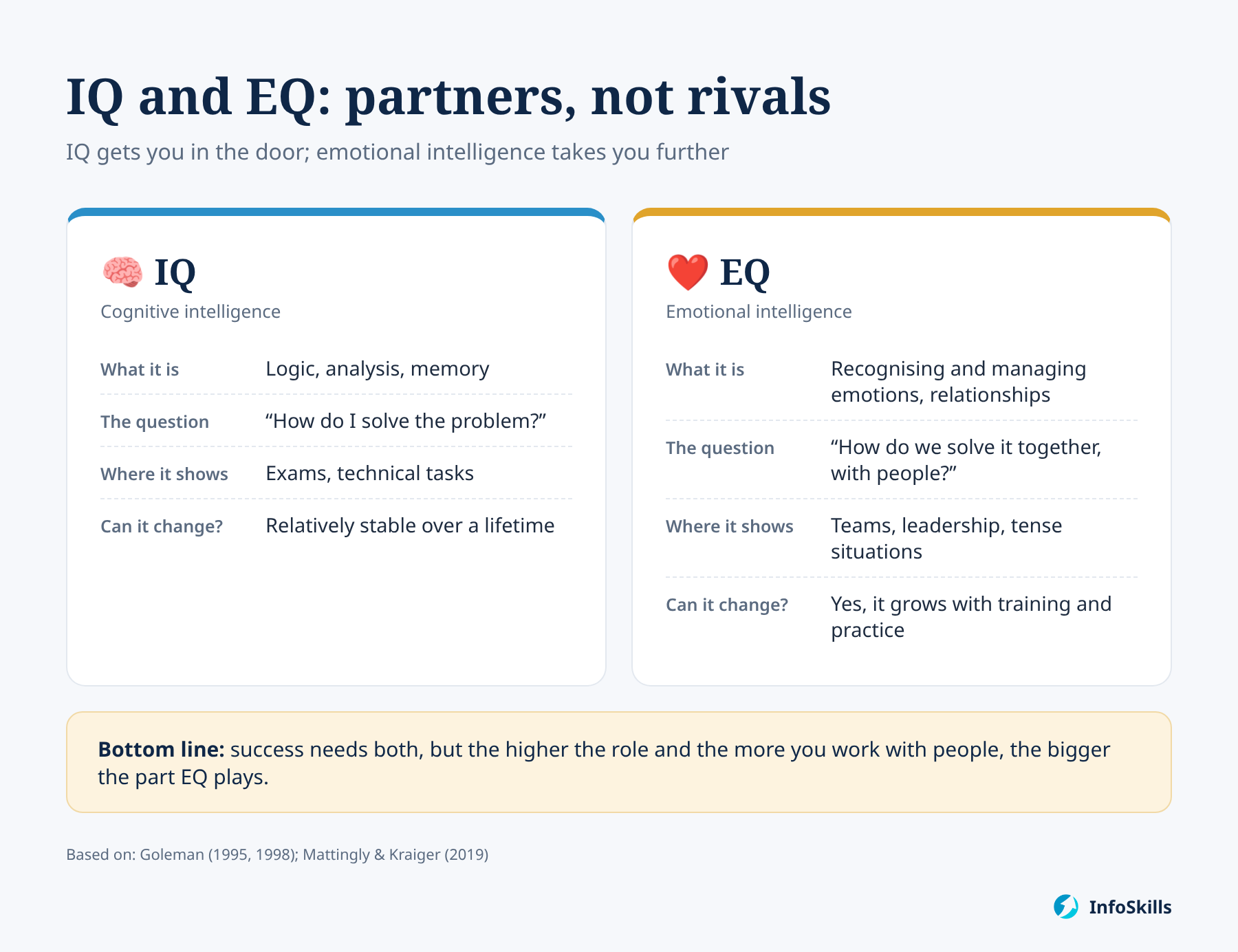
And most importantly: emotional intelligence can be learned. A meta-analysis of 58 studies found that targeted training has a moderate but consistent positive effect on emotional intelligence [5].
The 5 components of Goleman’s model
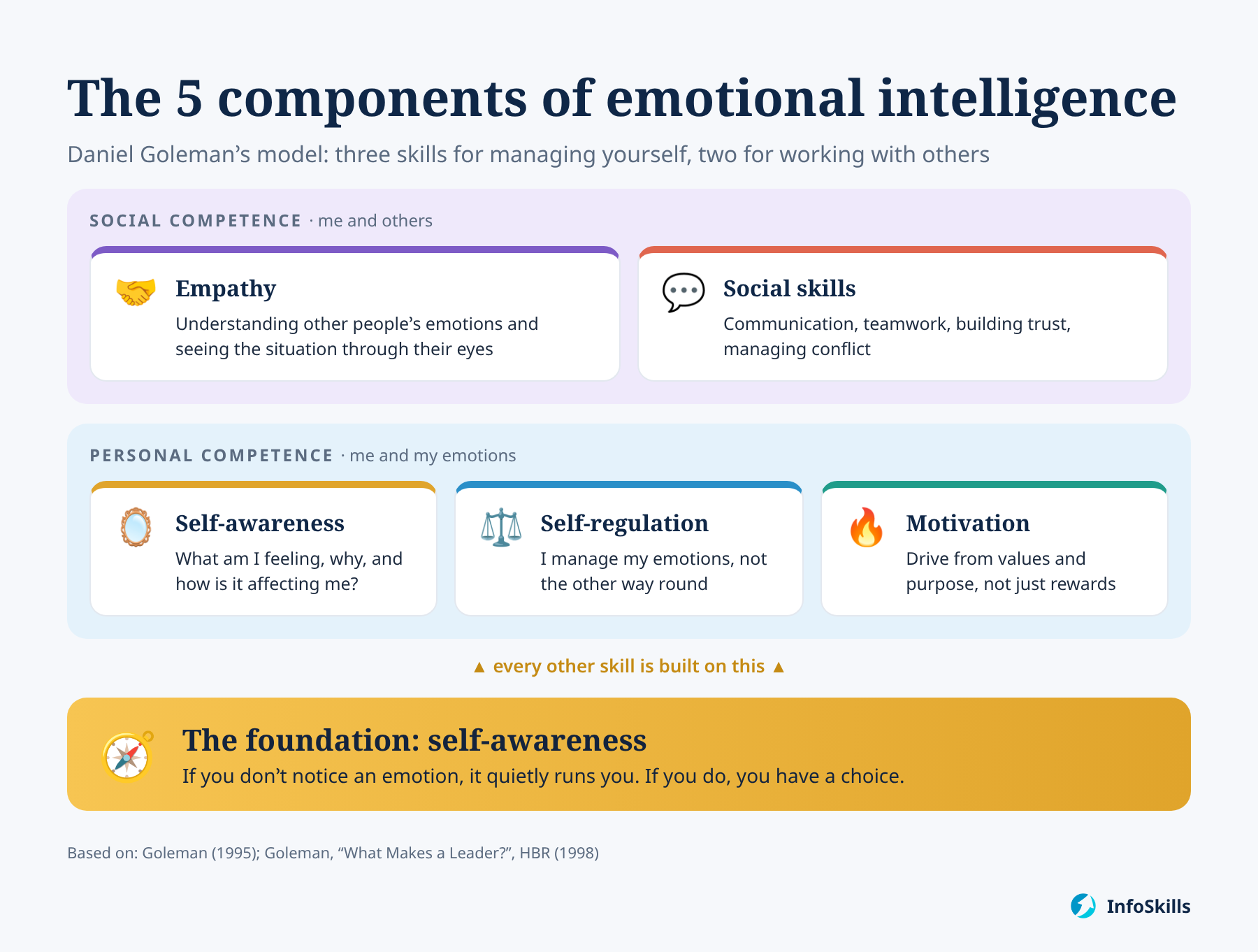
Goleman divides emotional intelligence into five components [1][4]. The first three concern our inner world, that is, how we manage ourselves; the last two concern our relationships with other people. And at the foundation of it all is self-awareness.
1. Self-awareness
What it is. The ability to notice and understand your own emotions, thoughts, values, strengths and weaknesses. Self-awareness is the answer to three questions:
- What am I feeling right now?
- Why am I feeling it?
- How is it affecting my behaviour?
Why it matters. Goleman calls self-awareness the first component of emotional intelligence and defines it as a deep understanding of one’s emotions, strengths, weaknesses, needs and drives [4]. If you don’t notice an emotion, it quietly runs you. If you do, you have a choice. The other components are built on this one.
In real life. A manager notices that when they are tired, they speak more harshly to their team. Having realised this, they move important conversations to the morning.
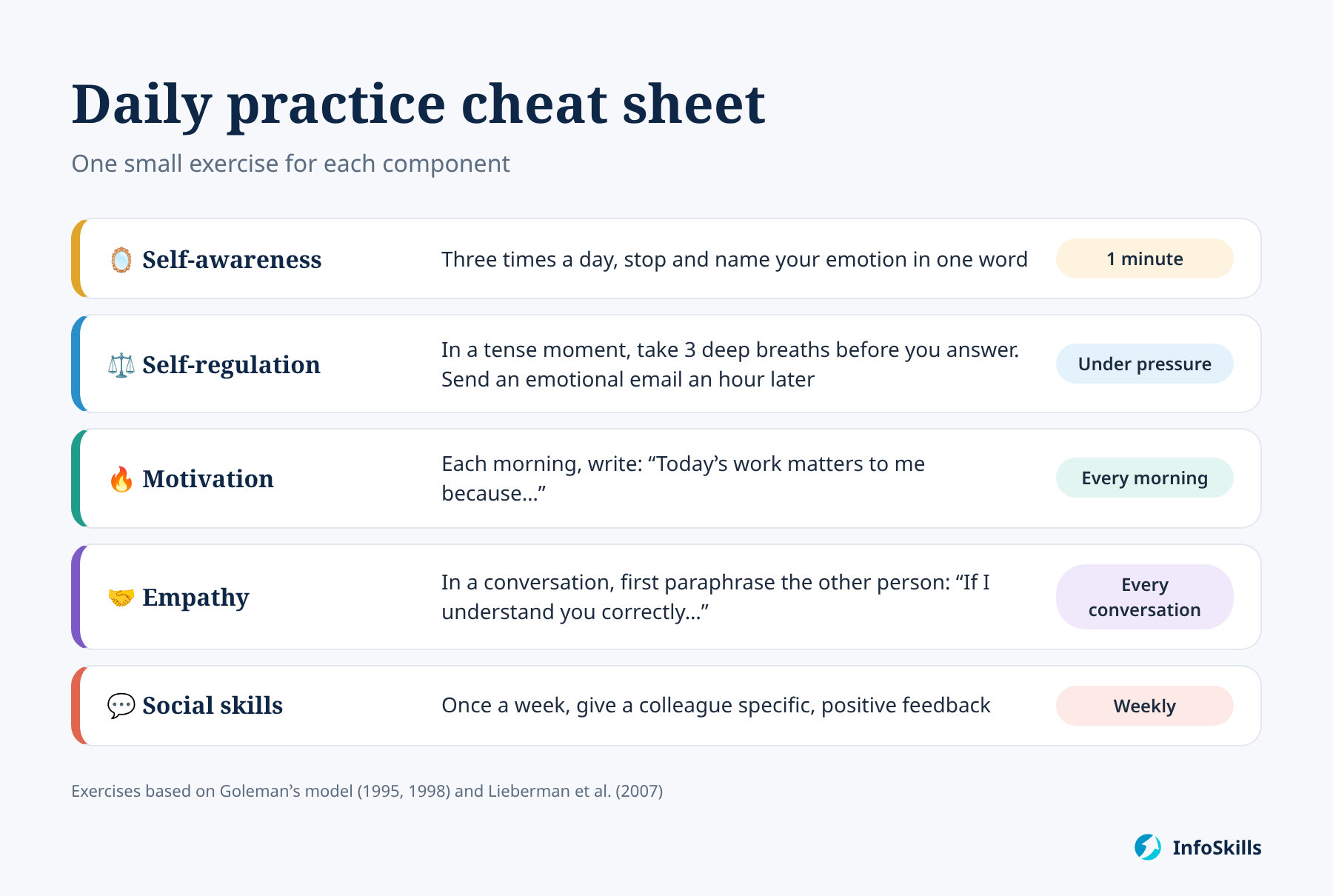
How to develop it. Several times a day, stop and name your emotion in one word: “anxiety”, “frustration”, “excitement”. This is more than a tip. Researchers at the University of California, Los Angeles (UCLA) used fMRI scans to show that when people put the emotion triggered by a negative image into words, activity drops in the amygdala, the brain’s centre of emotional reaction [6].
2. Self-regulation
What it is. Managing your emotions and impulses rather than letting them manage you.
Why it matters. Self-regulation does not mean suppressing emotions. Anger, fear and frustration are natural. The problem starts when they decide what we say and do. Goleman describes a phenomenon called “amygdala hijack”: when the amygdala perceives a situation as a threat, it reacts within milliseconds, before the thinking part of the brain has time to “switch on”, and we do something we later regret [1][7]. Self-regulation is that small pause between emotion and response where a conscious choice is born.
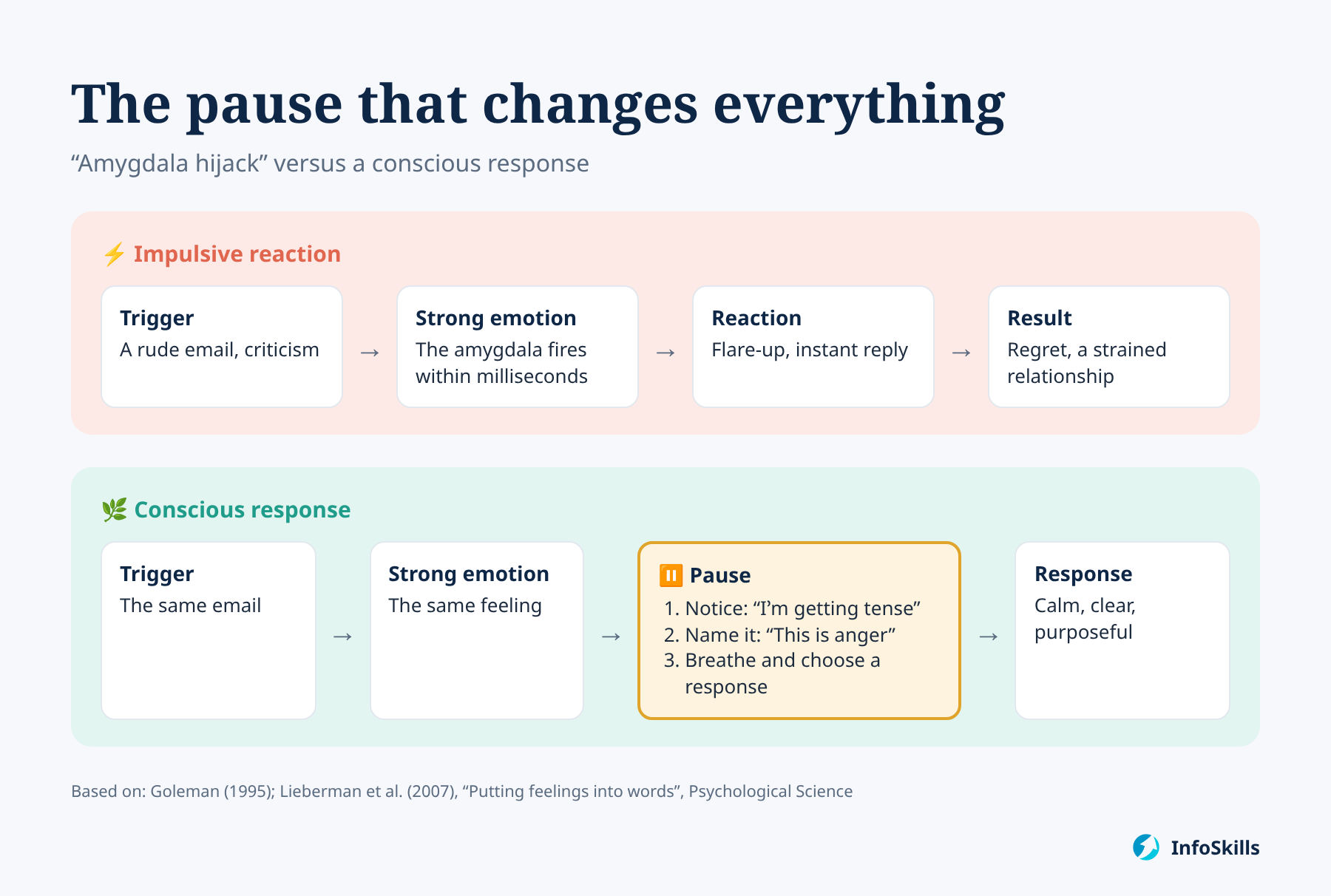
In real life. You receive a rude email. Your first urge is to reply straight away in the same tone. A self-regulated person writes the reply but sends it an hour later, after calmly rereading it.
How to develop it. When you feel yourself “boiling over”, use the “pause rule”: take a few deep breaths, count to ten, or simply say, “Let me think about that and get back to you.”
3. Motivation
What it is. A drive to work and grow that comes from within, from values, curiosity and purpose, not only from external rewards such as salary, praise or status.
Why it matters. External rewards are not always enough for the long road. Inner motivation helps you keep going when things get hard, and carry on when nobody is watching or praising you. Goleman lists “optimism, even in the face of failure” among the hallmarks of motivation [4].
In real life. A teacher learns a new method not because it is required, but because they want their students to understand the subject better.
How to develop it. For every important task, ask yourself: “Why does this matter to me?” Connect your daily work to a bigger purpose.
4. Empathy
What it is. The ability to understand other people’s emotions, needs and points of view, and to see a situation through their eyes.
Why it matters. Empathy is not weakness, and it does not mean always agreeing. It helps you understand what lies behind people’s words and actions, find the right words, prevent conflict and build trust. As Goleman explains, for a leader empathy does not mean adopting other people’s emotions as one’s own and trying to please everybody; it means thoughtfully considering employees’ feelings, along with other factors, in the process of making intelligent decisions [4].
In real life. An employee has been arriving late for several weeks. Instead of reprimanding them, the manager asks, “Is everything all right?” It turns out someone in their family is ill. Together they find a temporary solution, and the employee becomes one of the most loyal members of the team.
How to develop it. In conversations, listen to understand, not to reply. Pay attention not only to words, but also to tone, facial expression and body language.
5. Social skills
What it is. The ability to build and maintain effective relationships with people. It includes:
- effective communication,
- teamwork,
- building trust,
- managing conflict,
- influence and leadership.
Why it matters. This is where the other four components turn into action. Someone who knows and manages themselves, is motivated and understands others can bring a team together, persuade and resolve disagreements.
In real life. Two team members are arguing about the direction of a project. A leader with emotional intelligence does not pick a “winner”, but helps both of them listen to each other and find common ground.
How to develop it. Before an important conversation, think not only about what you want to say, but also about what the other person needs to hear.
Three common misconceptions
“Emotional intelligence means always being nice and pleasant.” No. Sometimes it means saying “no” calmly but clearly, giving difficult feedback or protecting your boundaries.
“Emotional people have high emotional intelligence.” Not necessarily. Having strong emotions and understanding and managing them are two different things.
“You’re either born with it or you’re not.” Not entirely. Goleman acknowledges that emotional intelligence has a genetic component, but stresses that it can be learned with sincere desire and concerted effort [4]. Research also shows that it grows with targeted training [5].
A word on the scientific debate
To be fair, there is a debate among scientists. Salovey, Mayer and Caruso see emotional intelligence as a distinct group of mental abilities: the capacity to process emotional information and use it to guide thinking and behaviour. They criticise approaches that group an “eclectic mix” of positive traits under this name, such as happiness, self-esteem and optimism [8]. Goleman’s model, which also covers motivation and social skills, is classed in the literature as a so-called “mixed model” [9].
Critics also warn that in some studies the predictive power of emotional intelligence drops noticeably once IQ and personality traits are taken into account, and that self-report tests can produce “socially desirable” answers [9].
In practice, this means emotional intelligence should not be seen as a miracle cure. But precisely because of its practical focus, Goleman’s model is today one of the most useful frameworks for anyone who wants to develop themselves and their teams in leadership, education and teamwork.
Daily practice: a cheat sheet
Emotional intelligence does not grow in one big leap, but through small, repeated habits. Here is one simple exercise for each component that you can start today.
Try it now: 1 minute
Take one minute and ask yourself:
- What emotion am I feeling right now? Name it in one word.
- What triggered it?
- How would I like to respond if the choice were entirely mine?
This small exercise is the first step towards self-awareness. The more often you do it, the more choice you have in how you respond.
Learn and practise with InfoSkills
Reading about emotional intelligence is an important start, but real change begins with practice.
By taking part in the InfoSkills “Self-Awareness” course, you will learn and apply not only this tool, but other effective tools and methods as well, which will help you understand yourself better, manage your emotions, communicate with confidence and lead.
In the course, every topic is reinforced through practical exercises, real-life situations and group work, so that knowledge becomes skill. And at the end, every participant leaves with a personal development and action plan.
Start the most important journey of all: the journey to yourself.
Sources
- Goleman, D. (1995). Emotional Intelligence: Why It Can Matter More Than IQ. New York: Bantam Books. en.wikipedia.org
- Gardner, H. (1983). Frames of Mind: The Theory of Multiple Intelligences. New York: Basic Books. en.wikipedia.org
- Salovey, P., & Mayer, J. D. (1990). Emotional intelligence. Imagination, Cognition and Personality, 9(3), 185–211. doi.org
- Goleman, D. (1998). What Makes a Leader? Harvard Business Review (reprinted January 2004, R0401H). hbr.org
- Mattingly, V., & Kraiger, K. (2019). Can emotional intelligence be trained? A meta-analytical investigation. Human Resource Management Review, 29(2), 140–155. doi.org
- Lieberman, M. D., Eisenberger, N. I., Crockett, M. J., Tom, S. M., Pfeifer, J. H., & Way, B. M. (2007). Putting feelings into words: Affect labeling disrupts amygdala activity in response to affective stimuli. Psychological Science, 18(5), 421–428. pubmed.ncbi.nlm.nih.gov
- Amygdala hijack. Wikipedia (with references to Goleman, 1995, 1996). en.wikipedia.org
- Mayer, J. D., Salovey, P., & Caruso, D. R. (2008). Emotional intelligence: New ability or eclectic traits? American Psychologist, 63(6), 503–517. doi.org
- Emotional intelligence. Wikipedia (sections “History”, “Mixed model”, “Criticisms”). en.wikipedia.org
Course: Self-Awareness
© 2026 InfoSkills, Վարուժան Ավանեսյան. Reuse only with the author's permission and a link to the source.


















No comments yet. Be the first.