Kolb's experiential learning model: how to learn from your own experience
Why two people draw different lessons from the same experience, and how to turn experience into knowledge and growth. David Kolb's learning cycle: 4 stages, 4 learning styles, the science behind them, diagrams and a daily practice cheat sheet.
Two colleagues have worked at the same company for ten years. The first grows wiser year after year: they know why one project succeeded and another did not, and in every new situation they act a little better than the last time. The second repeats the same mistakes again and again. As the saying goes, they do not have ten years of experience, but one year of experience repeated ten times.
What makes them different? Not the amount of experience. The difference is what they do with their experience.
The American educational theorist David Kolb [4] turned this difference into a simple, practical model that is used today in education, at work and in adult development [1]. In this article we look at what experiential learning is, how Kolb’s cycle works, what learning styles are, and how to learn from your own experience every day.
What is experiential learning?
Kolb’s idea is very simple: people really learn not only by reading or listening, but by living through something, trying it, and then understanding what that experience taught them.
Kolb himself put it this way: “Learning is the process whereby knowledge is created through the transformation of experience” [1][2].
In other words, experience on its own is not yet knowledge. It becomes knowledge when we stop, think about it, draw a conclusion and test that conclusion in practice. Learning is a cycle, not a single step.
Where the idea came from
Kolb did not start from scratch. His model rests on the work of three great 20th-century thinkers [1][2][3]:
- the educational philosophy of John Dewey,
- the developmental theories of Jean Piaget,
- the work of Kurt Lewin, from whom Kolb took the structure of the cycle.
Kolb developed the model with Ron Fry (1975), published his Learning Style Inventory in 1976, and set out the full theory in 1984 in the book Experiential Learning: Experience as the Source of Learning and Development [2]. A second, updated edition appeared in 2015 [1]. Kolb is Emeritus Professor of Organizational Behavior at the Weatherhead School of Management, Case Western Reserve University [4].
The 4 stages of the cycle
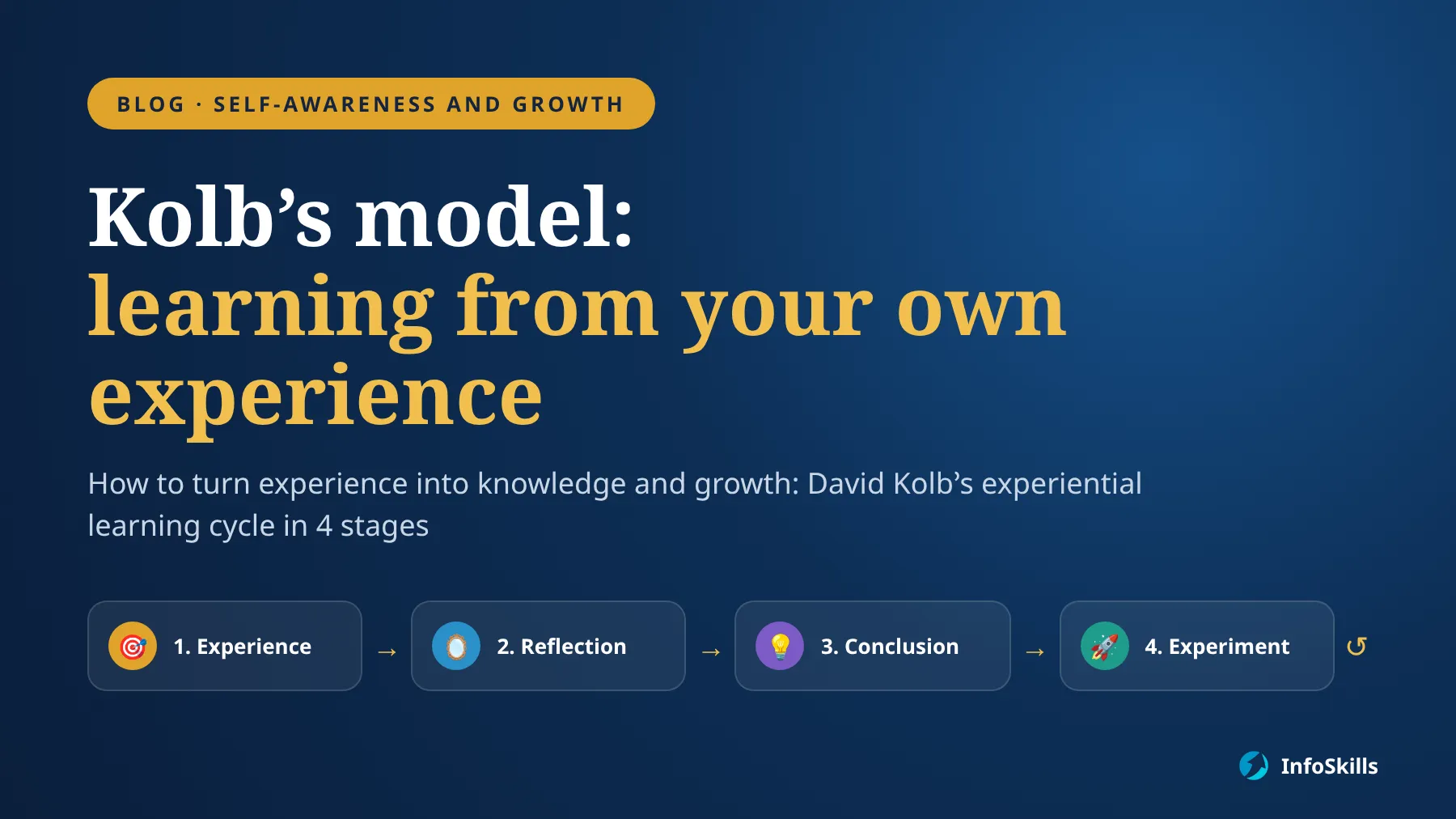
In Kolb’s model, learning is a cycle of four stages [1][2]. Each stage has its own key question.
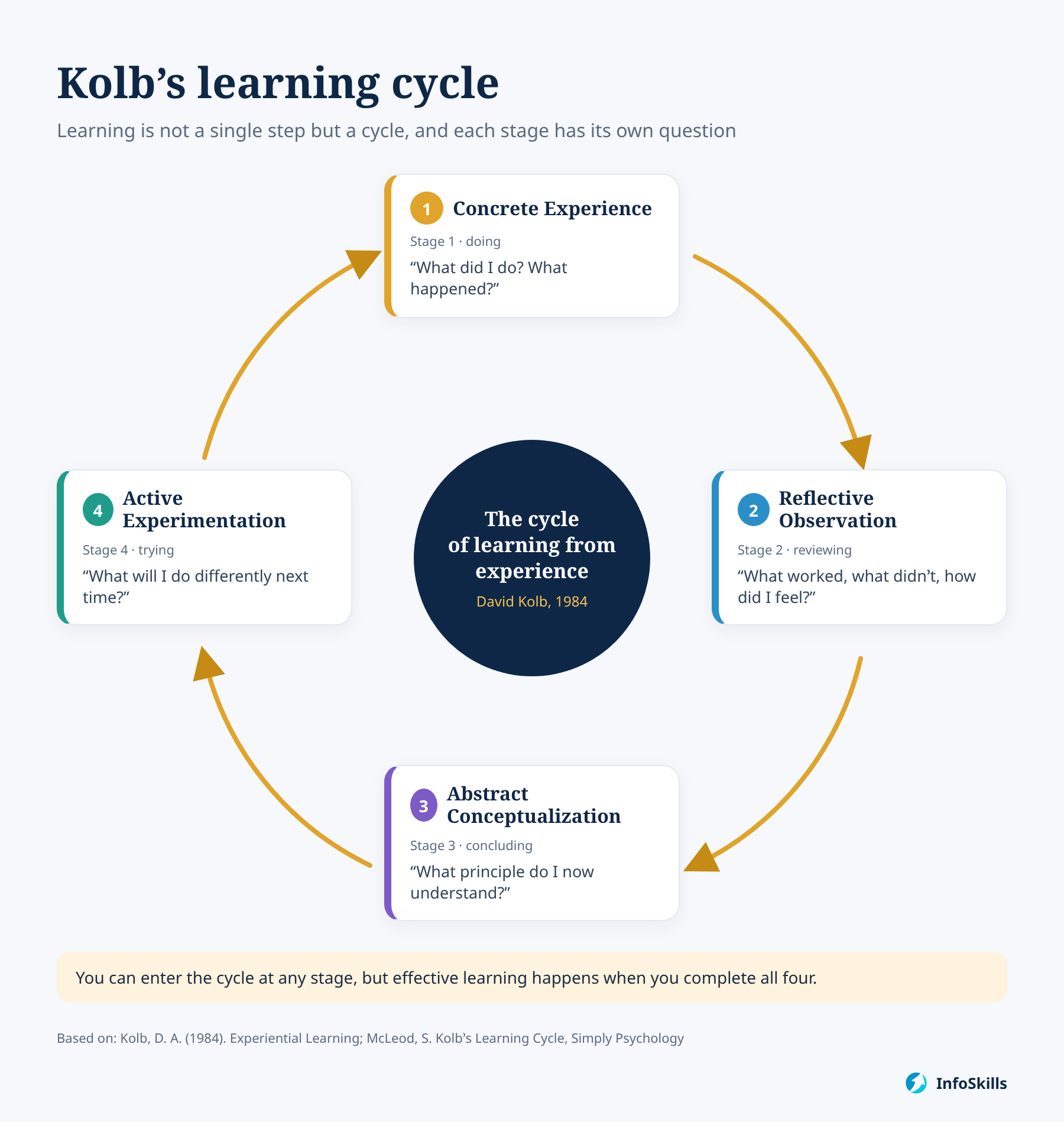
1. Concrete Experience
What it is. You do something, or find yourself in a new situation.
Example. You give a presentation, lead a team meeting or take part in a difficult negotiation.
2. Reflective Observation
What it is. You stop and look back at what happened, in the light of what you already know [2]. The questions here are simple:
- What worked?
- What didn’t work?
- How did I feel?
- How did others react?
This is the stage we skip most often, because we are always rushing on to the next task.
3. Abstract Conceptualization
What it is. Reflection gives rise to a new idea, or changes an existing one [2]. You understand a principle that applies beyond this one case.
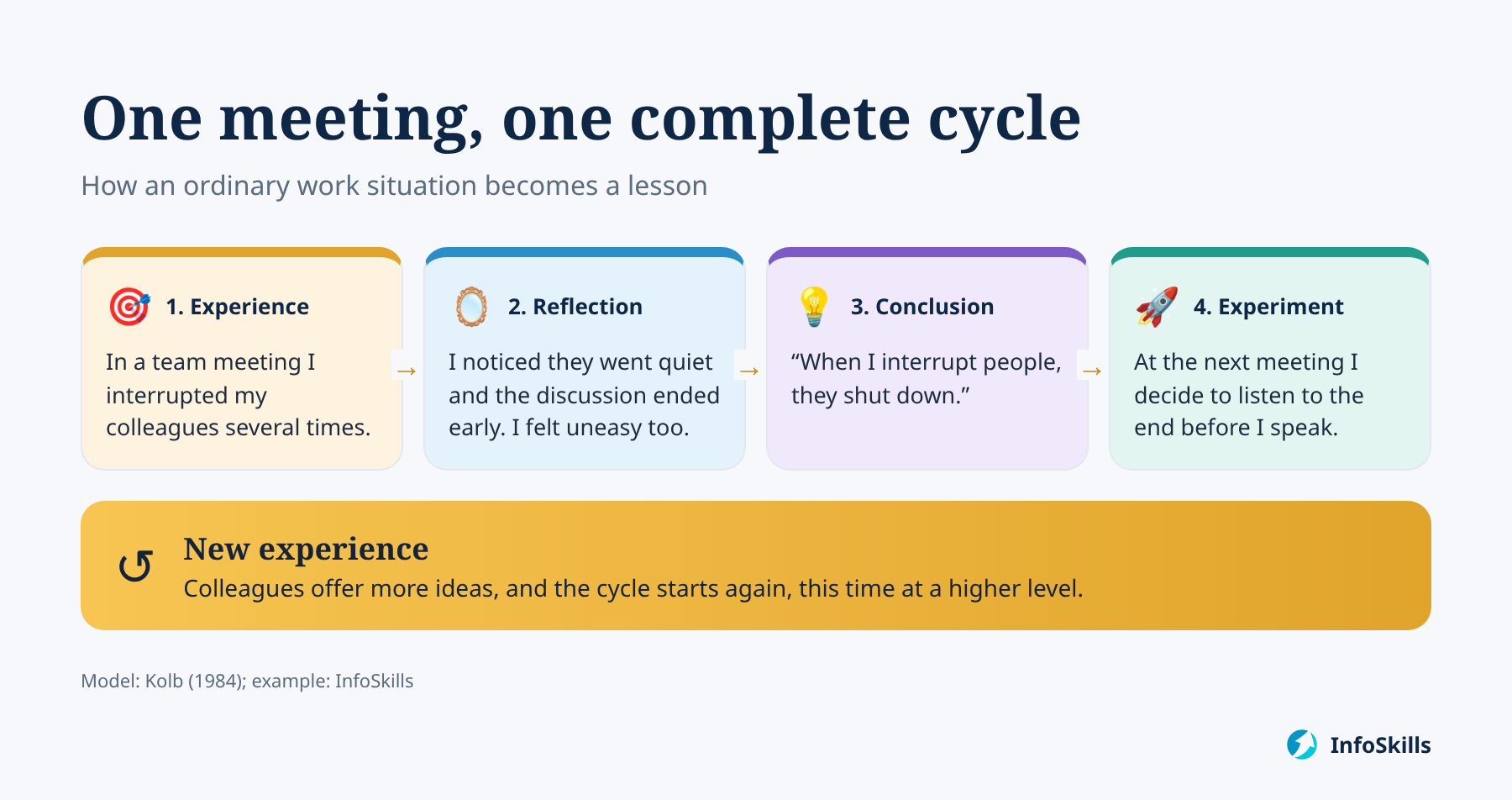
Example. “When I interrupt people, they shut down.”
4. Active Experimentation
What it is. You test the new conclusion in practice [2].
Example. At the next meeting you decide to listen more and to speak only once the other person has finished their thought.
And the cycle starts again, because that experiment is itself a new experience.
An important detail: you can enter the cycle at any stage, but effective learning only happens when a person completes all four stages [2]. If you only act and never think, you repeat the same thing. If you only think and never try, nothing changes.
Example: one meeting, one complete cycle
Here is how an ordinary work situation becomes a lesson once it goes through all four stages.
Why this is the key to self-awareness
Self-awareness is not born from inner dialogue alone. It is born at the moment we look at our own actions and ask, “What did I do, what did I feel, and why?” That is exactly the second stage of Kolb’s cycle.
Kolb’s model develops:
- self-reflection: the habit of looking back and understanding,
- awareness of your own behaviour: how your actions affect others,
- the ability to learn from mistakes: a mistake becomes information, not failure,
- adaptability: after every cycle we act a little better,
- management and leadership skills, which grow out of real experience.
This is more than theory. Researchers Giada Di Stefano, Francesca Gino, Gary Pisano and Bradley Staats ran an experiment at a technical support call centre of the company Wipro in Bangalore, India [5]. On days 6 to 16 of their training, one group of new employees spent the last 15 minutes of each day writing about what they had learned. The control group simply kept working for those 15 minutes. On the final training test, the reflection group scored 22.8% higher, and the group that also spent 5 minutes explaining their notes to a colleague scored 25% higher [5].
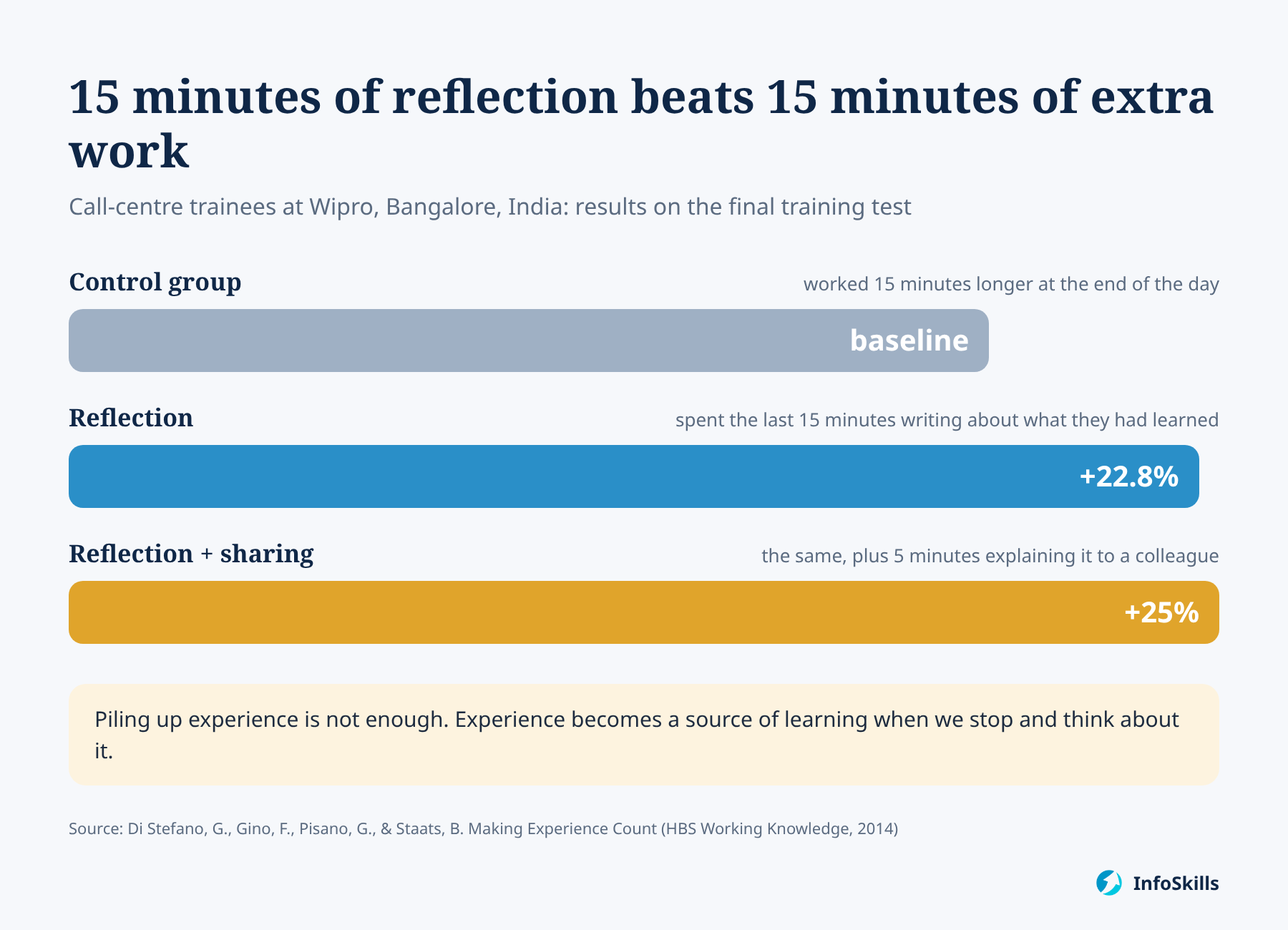
In other words, working more does not always mean learning more. Sometimes the most productive step is to stop and think.
The 4 learning styles
Kolb noticed that people prefer the stages of the cycle in different ways. His model has two axes [2][3]:
- how we perceive information: by feeling (concrete experience) or by thinking (abstract conceptualization),
- how we process it: by doing (active experimentation) or by watching (reflective observation).
Combining these two axes gives four learning styles [2][3]:
- 🔹 Diverging: feeling + watching. Sees situations from different perspectives.
- 🔹 Assimilating: thinking + watching. Takes a concise, logical approach.
- 🔹 Converging: thinking + doing. Prefers practical and technical tasks.
- 🔹 Accommodating: feeling + doing. Hands-on, relying on intuition rather than logic.
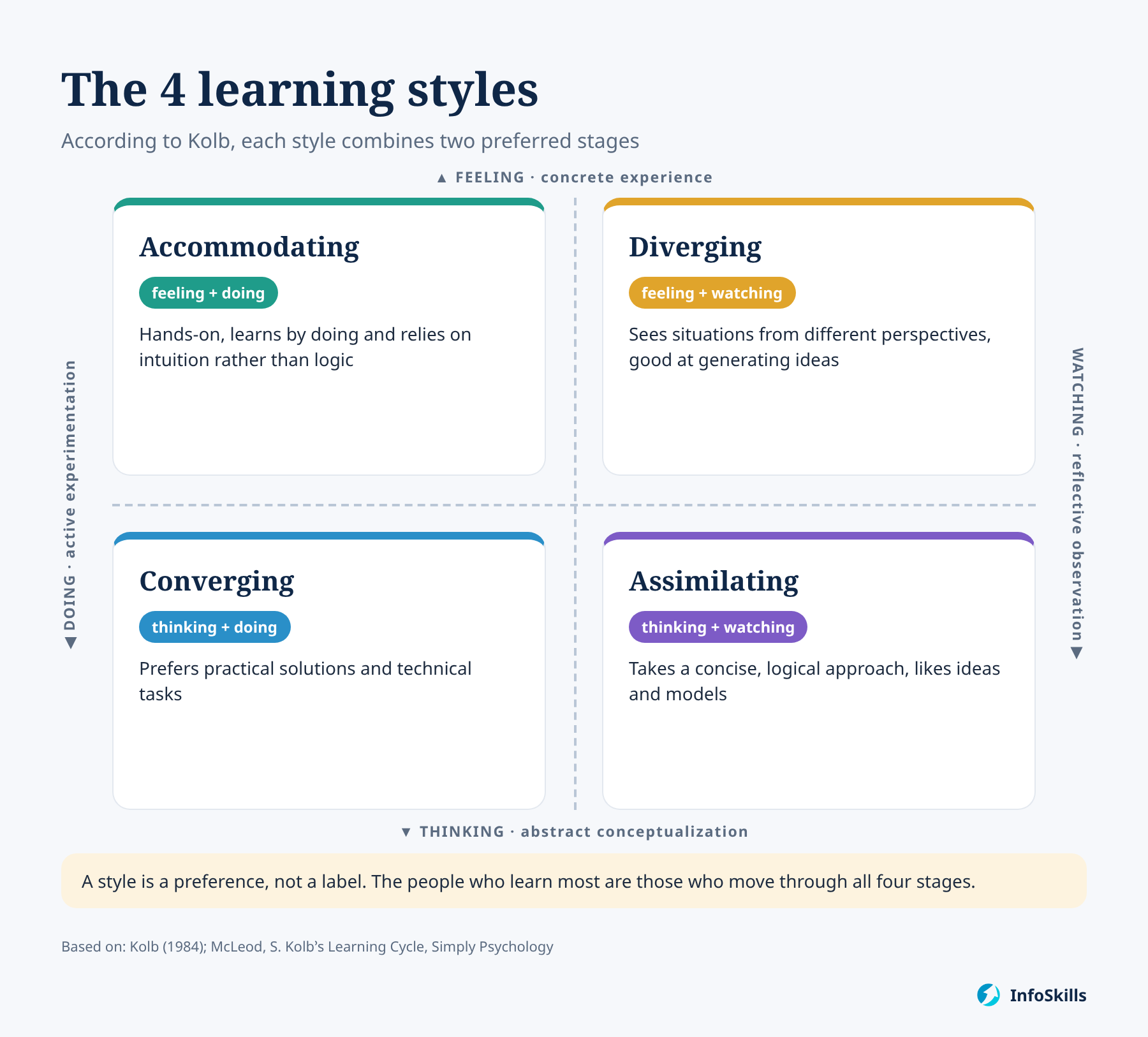
According to Kolb, a person’s preferred style is shaped by their social environment, their educational experiences and their basic cognitive structure [2]. Understanding styles helps explain why one team member wants to “just try it”, another wants to analyse everything in detail first, and a third wants to hear everyone’s opinion. That is a difference, not a problem.
A word on the scientific debate
To be fair, Kolb’s model has its critics too. Some consider it overly simplistic and linear; others point out that it focuses on the individual’s inner processes and pays little attention to social and cultural context [2].
The more serious debate concerns learning styles. In 2008 the psychologists Harold Pashler, Mark McDaniel, Doug Rohrer and Robert Bjork reviewed the research in this area and concluded that there is no adequate evidence base to justify incorporating learning-styles assessments into general educational practice [6]. In other words, there is no solid scientific proof that people learn better when teaching is “matched” to their style.
The practical conclusion: a learning style is useful as a mirror for self-knowledge, but not as a label (“I’m a practical person, I don’t need theory”). The main value of Kolb’s cycle lies not in the styles but in a simple principle: experience becomes a source of learning only when we go through all four stages.
Daily practice: a cheat sheet
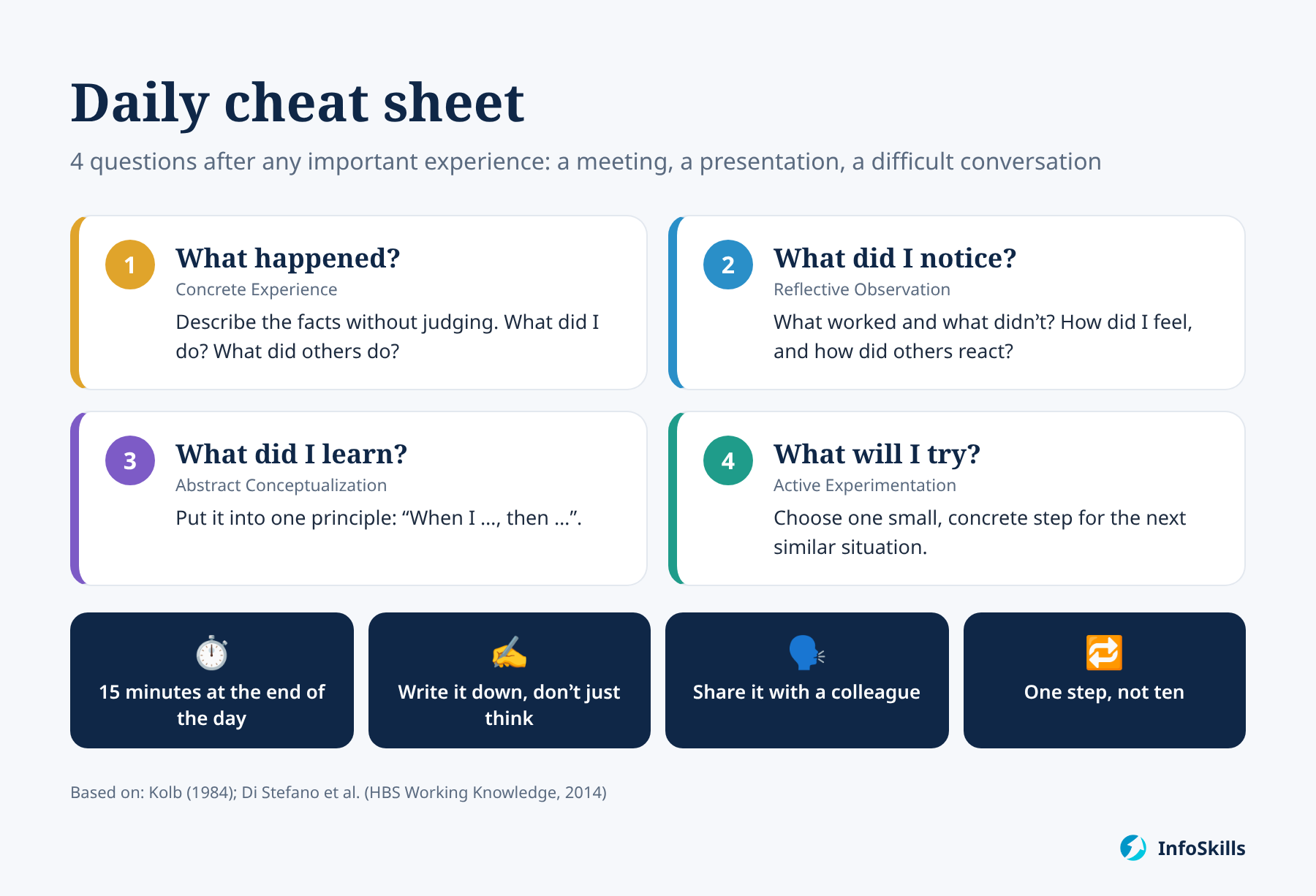
Kolb’s cycle does not only work in training courses. You can apply it after any important experience: a meeting, a presentation, a difficult conversation, a new project.
Try it today: 15 minutes
At the end of the day, take 15 minutes, choose one situation from today and answer in writing:
- What happened? Describe the facts without judging.
- What did I notice? What worked, what didn’t, how did I feel?
- What did I learn? Put it into one principle: “When I …, then …”.
- What will I try? Choose one small, concrete step for next time.
If you can, share your notes with a colleague. As the Wipro experiment showed, this strengthens the effect [5].
Learn and practise with InfoSkills
Reading about Kolb’s model is an important start, but real change begins with practice.
By taking part in the InfoSkills “Self-Awareness” course, you will learn and apply not only this tool, but other effective tools and methods as well, which will help you know yourself better, learn from your own experience and grow consciously.
In the course, every topic is reinforced through practical exercises, real-life situations and group work, so that knowledge becomes skill. And at the end, every participant leaves with a personal development and action plan.
If mindfulness teaches us to notice the present moment, and emotional intelligence teaches us to manage our emotions, Kolb’s model teaches us to learn from our own experience and keep growing.
Sources
- Kolb, D. A. (1984). Experiential Learning: Experience as the Source of Learning and Development. Englewood Cliffs, NJ: Prentice-Hall; 2nd ed., Pearson, 2015. pearson.com
- McLeod, S. Kolb’s Learning Cycle (Kolb’s Learning Styles & Experiential Learning Cycle). Simply Psychology (citing Kolb, 1984, p. 38; Kolb & Fry, 1975; Pashler et al., 2008). simplypsychology.org
- Kolb’s experiential learning. Wikipedia. en.wikipedia.org
- David A. Kolb. Wikipedia. en.wikipedia.org
- Nobel, C. (2014, May 5). Reflecting on Work Improves Job Performance. Harvard Business School Working Knowledge (on the study by Di Stefano, G., Gino, F., Pisano, G., & Staats, B., Making Experience Count: The Role of Reflection in Individual Learning). library.hbs.edu
- Pashler, H., McDaniel, M., Rohrer, D., & Bjork, R. (2008). Learning styles: Concepts and evidence. Psychological Science in the Public Interest, 9(3), 105–119. doi.org
Course: Self-Awareness
© 2026 InfoSkills, Varuzhan Avanesyan. Reuse only with the author's permission and a link to the source.















No comments yet. Be the first.