
The Pomodoro Technique: how to turn 25 minutes into a tool for focus
Starting a big task is often harder than doing it. We look at Francesco Cirillo's Pomodoro Technique: where it came from, its rules, the science behind it, examples and a practical cheat sheet.


You need to write a report. You open the file, look at the blank page, and suddenly remember that you haven’t checked your email. Then a message arrives, then a colleague asks a question, then you check the news “for just a minute”. At the end of the day, the report still hasn’t started.
Sound familiar? The problem is often not a lack of time or knowledge. The problem is that the task feels too big, and our attention is pulled in every direction.
One of the simplest and best-known solutions to this problem fits on a kitchen timer. It is called the Pomodoro Technique. In this article we look at where it came from, how it works, what research says about it, and how to apply it starting today.
What is the Pomodoro Technique?
In one sentence: the Pomodoro Technique is a time management method that improves focus by working in short, intensive intervals separated by short breaks [1][2].
Its central idea is simple: focused work in short intervals.
In plain language:
- 👉 work for 25 minutes with full focus,
- 👉 then take a 5-minute break,
- 👉 after four such intervals, take a longer break.
Each 25-minute interval is called a “pomodoro”.
Where the name came from
The method was created in the late 1980s by the Italian Francesco Cirillo [1][2]. As a university student he struggled to concentrate on his studies, and he decided to test himself: could he study with full focus for just a few minutes? To measure the time he used a kitchen timer shaped like a tomato. In Italian, tomato is pomodoro, and that is how the method got its name [1][2].
In 2006 Cirillo described the method in a book that he offered as a free download for several years [3]. In 2018 an expanded edition, The Pomodoro Technique, was published by Penguin Random House [3].
How the cycle works
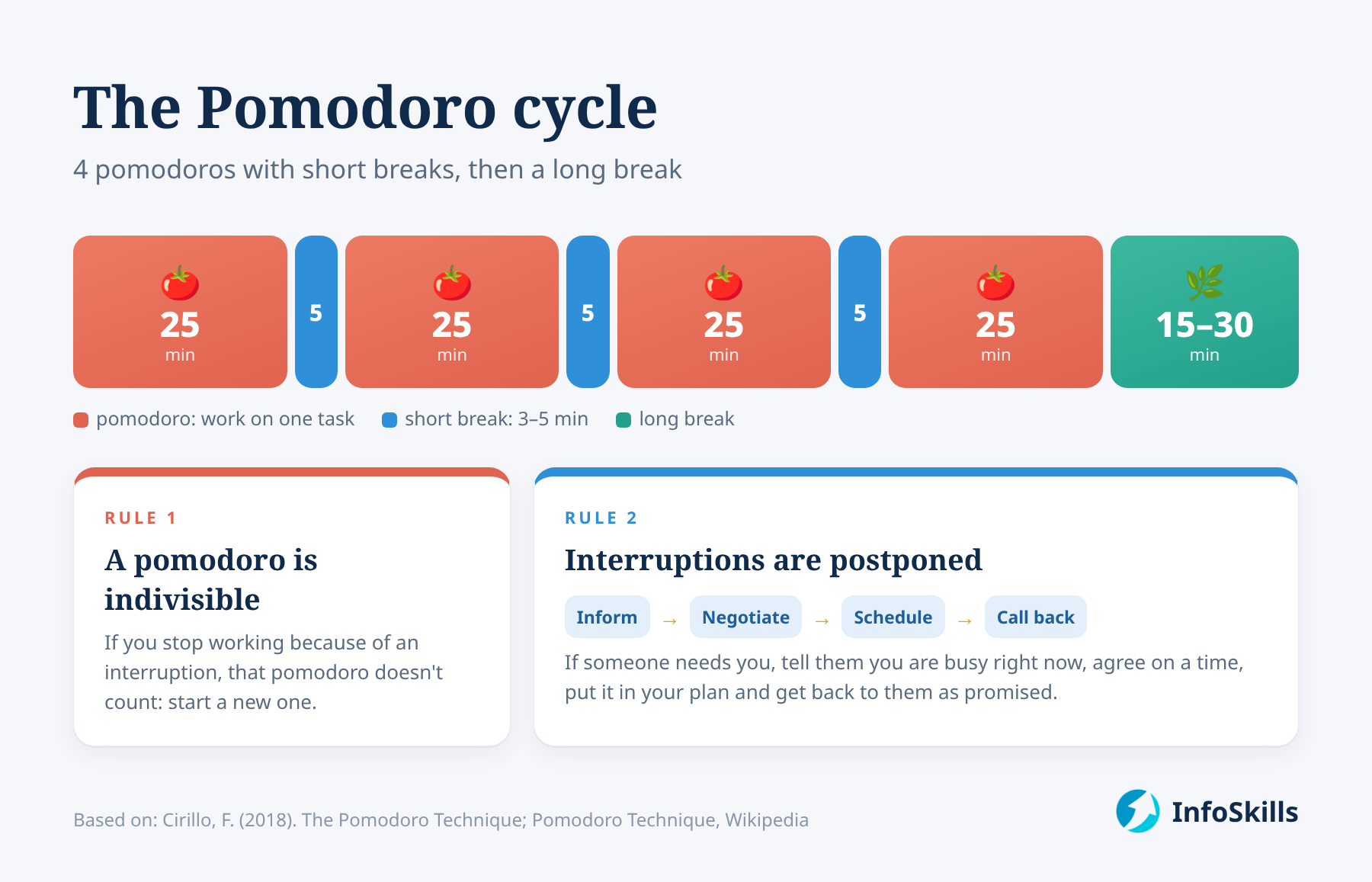
The classic cycle looks like this [1]:
- 1 pomodoro = 25 minutes of work on one task,
- short break = 3–5 minutes,
- after 4 pomodoros, a long break of 15–30 minutes.
Two rules from the original method make it more than “just a timer” [1][3]:
- A pomodoro is indivisible. If you are interrupted and stop working, that pomodoro doesn’t count; you start a new one.
- Interruptions are postponed, not ignored. If someone needs you, the original method suggests a four-step strategy: inform the person that you are busy right now, negotiate a time, schedule it, and call back as promised [1].
How to apply it: 5 steps
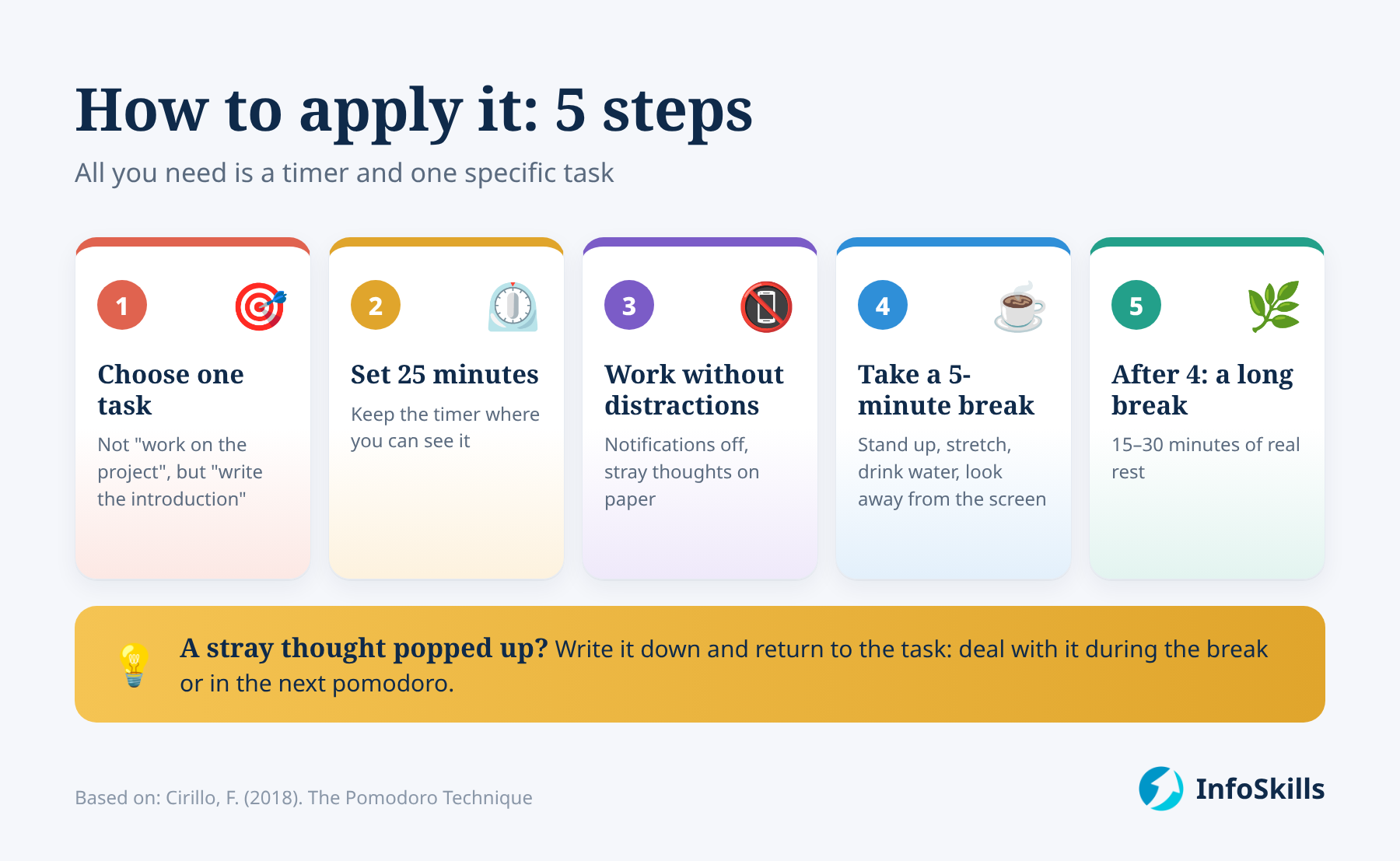
- Choose one specific task. Not “work on the project”, but “write the introduction of the report”.
- Set a timer for 25 minutes.
- Work without distractions. Phone face down, notifications off, one tab open. If an unrelated thought comes up, write it down on paper and return to the task.
- When the timer rings, take a 5-minute break. Stand up, stretch, drink water. Better not to look at the screen.
- After every 4 pomodoros, take a long break of 15–30 minutes.
Why it works: what research says
The Pomodoro Technique is simple, but the mechanisms behind it are well studied.
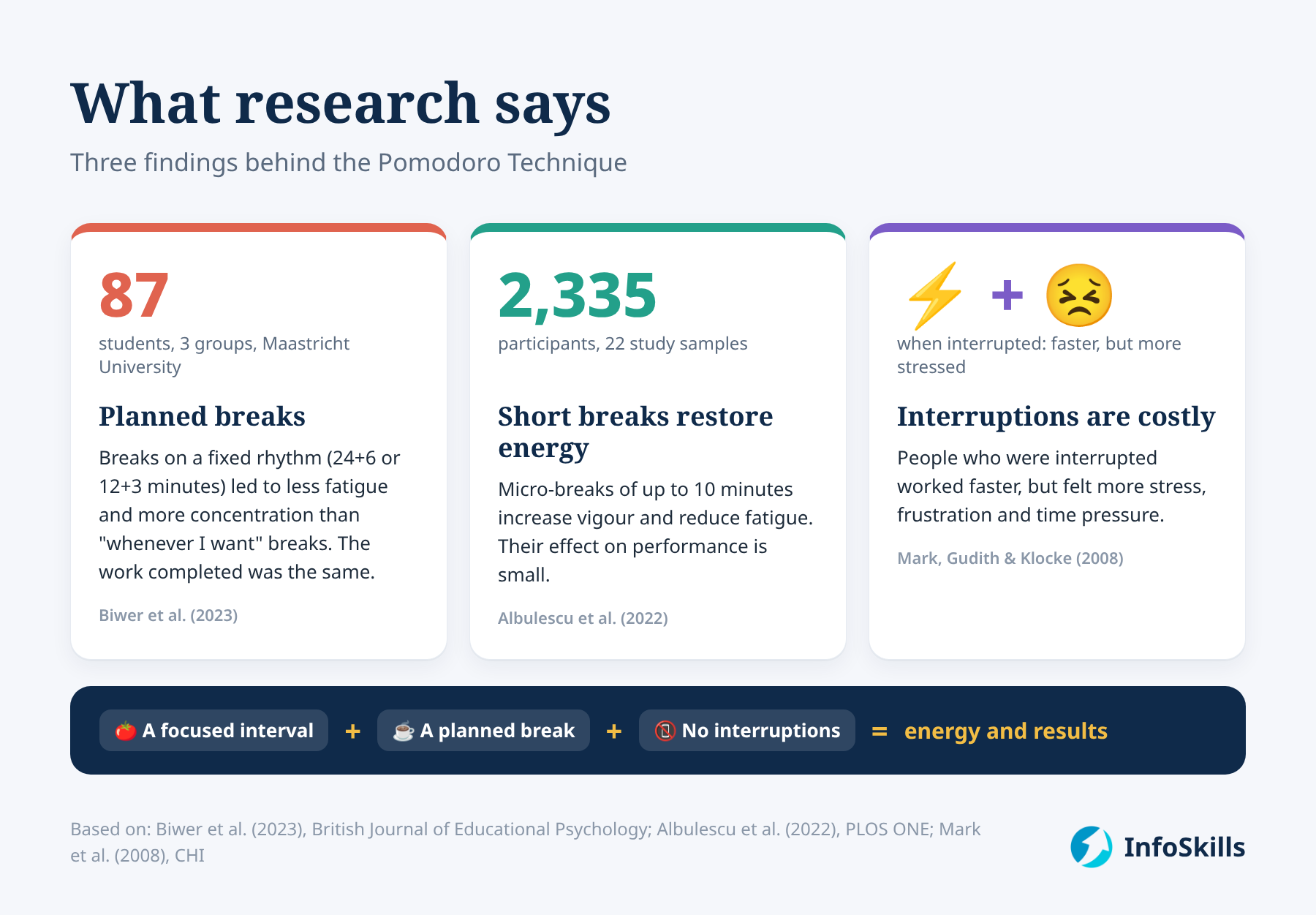
1. Planned breaks are better than “I’ll rest when I’m tired”. Researchers at Maastricht University (Biwer and colleagues) compared three groups of 87 students [4]. One group took breaks whenever they wanted. The other two followed a fixed schedule: a 6-minute break after every 24 minutes (a Pomodoro-like rhythm) or a 3-minute break after every 12 minutes. Students who took breaks on their own studied for longer stretches, but reported more fatigue and distraction, and less concentration and motivation. The amount of work completed was the same in all groups [4]. In other words, planned breaks achieved the same result with a better mood and in less time.
2. Short breaks restore energy. A meta-analysis by Patricia Albulescu and colleagues combined 22 study samples with 2,335 participants [5]. Micro-breaks of up to 10 minutes increased vigour and reduced fatigue. Their effect on overall performance was small and not statistically significant, and it was clearer for less demanding tasks; longer breaks were associated with a larger performance boost [5]. The practical conclusion: short breaks are first of all about energy and well-being, and for very demanding work a longer break may be needed.
3. Interruptions cost more than they seem. In an experiment by Gloria Mark and colleagues at the University of California, Irvine, people who were interrupted completed their tasks faster and with the same quality, but paid for it with more stress, frustration, time pressure and effort [6]. A protected 25-minute block reduces exactly these interruptions.
Why it helps against procrastination
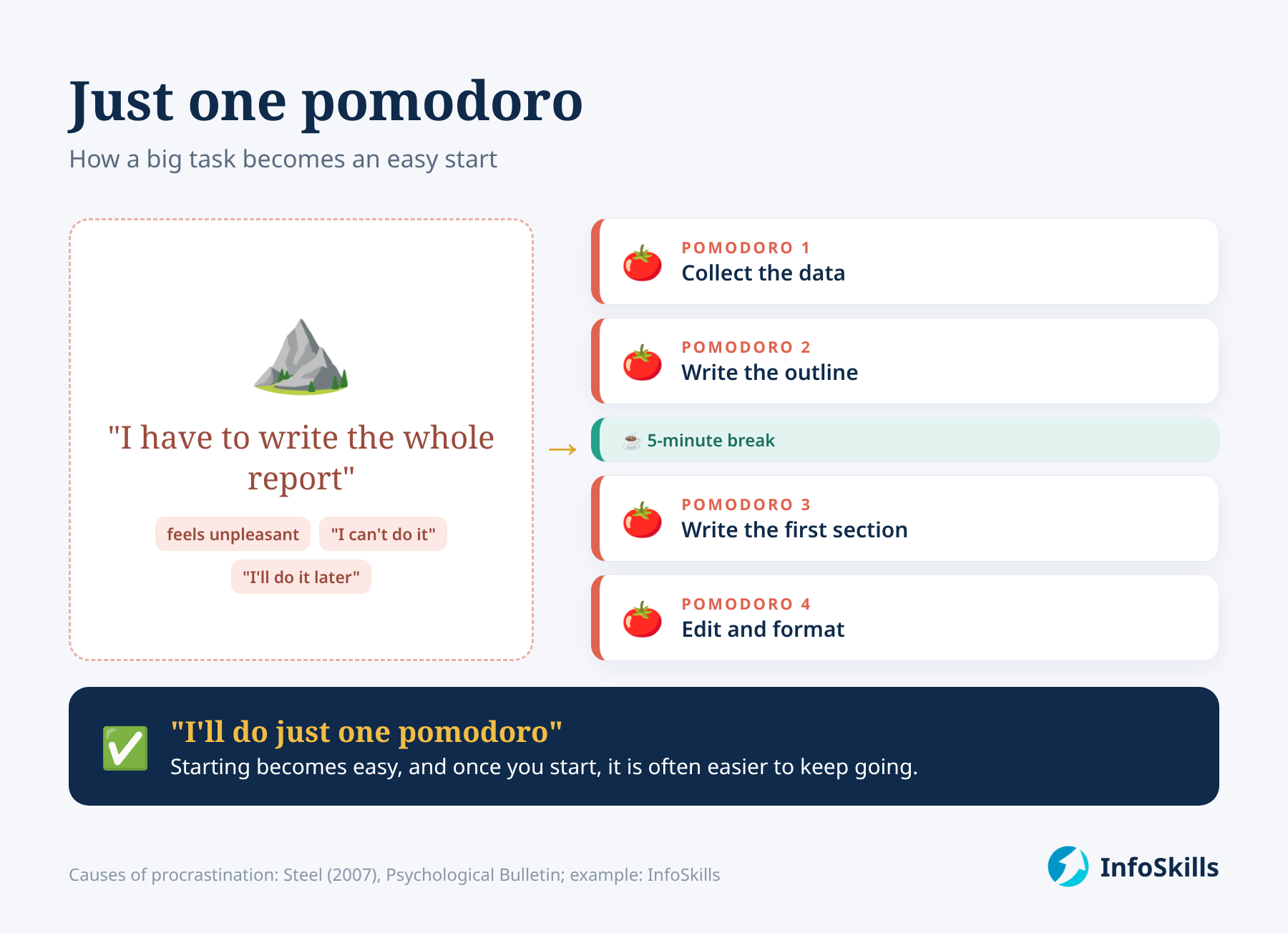
Psychologist Piers Steel brought together 691 correlations from procrastination research in a meta-analysis and found that it is most strongly linked to how unpleasant the task feels, to low confidence in one’s own ability, and to impulsiveness [7]. A big, vague task (“I need to write the whole report”) feels heavy and unpleasant.
The Pomodoro Technique changes the size of the task in our mind. Instead of “the whole report”, the task becomes “just one pomodoro”: 25 minutes, and then a break. Starting becomes much easier, and once you start, it is often easier to continue.
A simple example
You need to prepare a report and can’t get started.
❌ Instead of saying: “I have to do the whole thing.”
✅ Say: “I’ll do just one pomodoro.”
The first pomodoro: collect the data. The second: write the outline. The third: write the first section. By the end of the day, the “impossible” report is half done.
What this method develops
- ✅ focus,
- ✅ attention management,
- ✅ control over time,
- ✅ fewer distractions,
- ✅ productivity,
- ✅ better distribution of mental energy and prevention of fatigue.
Why it matters
- It is easy to apply: all you need is a timer.
- It helps you start difficult tasks.
- It reduces the habit of putting things off.
- It makes time visible: you know how many pomodoros a task really takes.
📌 Best suited for: students, creative professionals and office workers, and anyone whose work requires concentration.
Adapt it to yourself
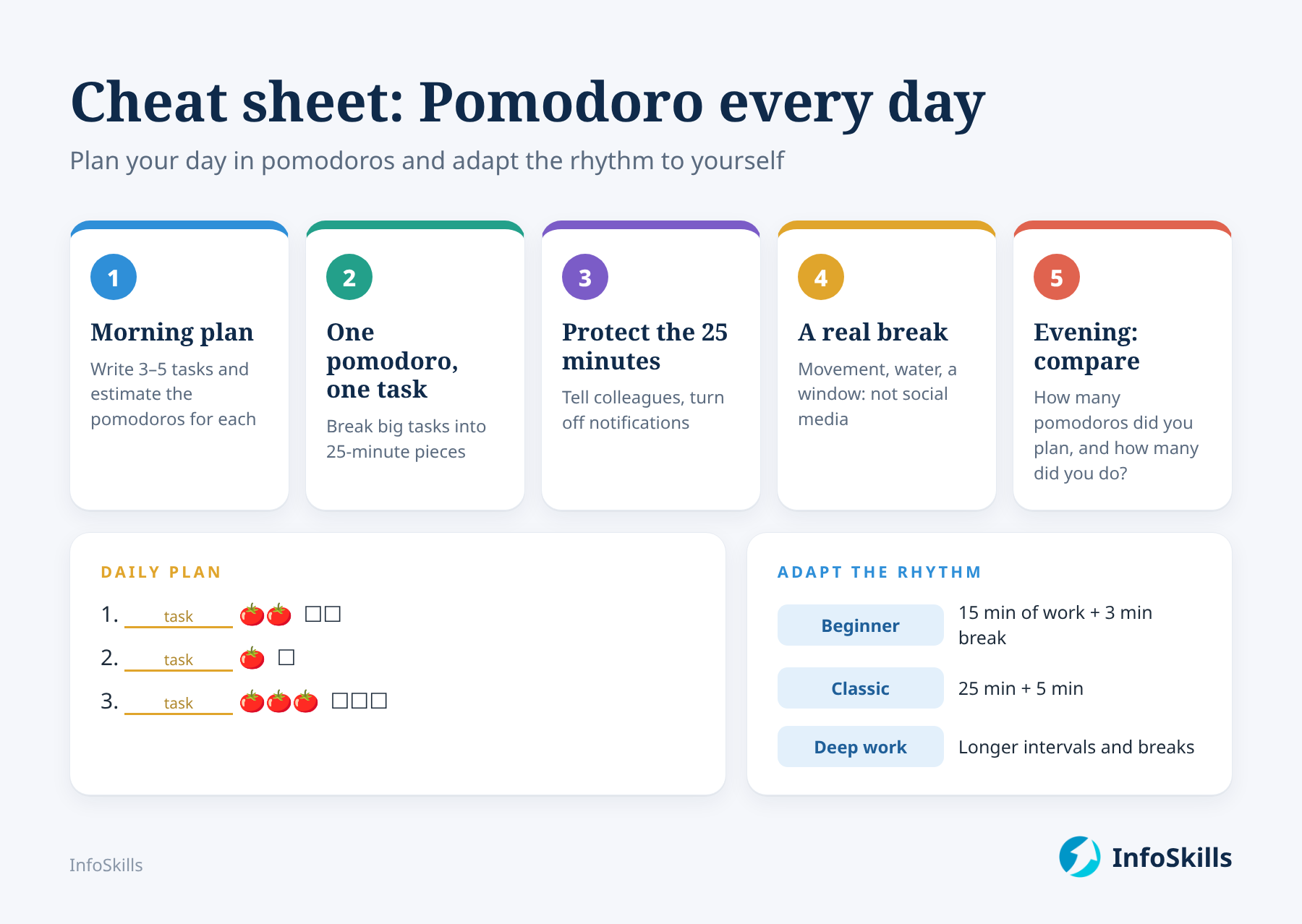
25 minutes is a starting point, not a law. If your work requires deep immersion (writing code, analysis, design), you can try longer intervals; if focus is hard at first, start with shorter ones. In the Maastricht study, a 12-minute rhythm also worked [4]. What matters most is the principle: a fixed block of focused work and a planned break.
In summary
Big tasks are easy to handle when we divide them into small, focused intervals. The Pomodoro Technique teaches you not to fight time, but to work with it: a short sprint, a short rest, and then again.
25 minutes of full attention = high effectiveness.
Learn and practise with InfoSkills
The Pomodoro Technique is one of the simplest tools for managing time and attention, but it works best together with other skills: setting priorities, planning and saying “no”.
By taking part in the InfoSkills “Time Management” course, you will learn and apply not only this tool, but other effective tools and methods as well, which will help you set clear priorities, stay focused and get important things done on time.
In the course, every topic is reinforced through practical exercises, real-life situations and group work, so that knowledge becomes skill. And at the end, every participant leaves with a personal development and action plan.
Sources
- Pomodoro Technique. Wikipedia. en.wikipedia.org
- Cirillo, F. The Pomodoro® Technique: official website (the creator’s account of how the method began). pomodorotechnique.com
- Cirillo, F. (2018). The Pomodoro Technique: The Acclaimed Time-Management System That Has Transformed How We Work. New York: Currency (Penguin Random House); first self-published in 2006. penguinrandomhouse.com
- Biwer, F., Wiradhany, W., oude Egbrink, M. G. A., & de Bruin, A. B. H. (2023). Understanding effort regulation: Comparing ‘Pomodoro’ breaks and self-regulated breaks. British Journal of Educational Psychology, 93(2), 353–367. pubmed.ncbi.nlm.nih.gov
- Albulescu, P., Macsinga, I., Rusu, A., Sulea, C., Bodnaru, A., & Tulbure, B. T. (2022). “Give me a break!” A systematic review and meta-analysis on the efficacy of micro-breaks for increasing well-being and performance. PLOS ONE, 17(8), e0272460. doi.org
- Mark, G., Gudith, D., & Klocke, U. (2008). The cost of interrupted work: More speed and stress. Proceedings of the SIGCHI Conference on Human Factors in Computing Systems (CHI ‘08), 107–110. doi.org
- Steel, P. (2007). The nature of procrastination: A meta-analytic and theoretical review of quintessential self-regulatory failure. Psychological Bulletin, 133(1), 65–94. doi.org
Course: Time Management
© 2026 InfoSkills, Varuzhan Avanesyan. Reuse only with the author's permission and a link to the source.


















No comments yet. Be the first.