
The Shannon–Weaver model: why messages get lost on the way, and how to reduce the noise
You said one thing, and the other person heard something quite different. We look at the classic linear model of communication, the Shannon–Weaver model: its elements, the types of noise, where it came from, its limits, and a practical cheat sheet for business communication.


A manager writes in the team chat: “I need the report by the end of the day.” The manager means 6 pm today. The employee reads “the end of the day” as “before I come in tomorrow morning”, and also isn’t sure which report is meant: the weekly one or the client one. At 6:15 pm the manager is annoyed, and the employee is surprised.
Nobody lied and nobody was lazy. The message simply changed on its way from one head to another. Where exactly did that happen, and how can it be prevented?
In this article we look at one of the first and best-known models of communication, the Shannon–Weaver model: what elements it consists of, what “noise” is, where the model came from, what it does not describe, and how to use it in everyday business communication.
What is the Shannon–Weaver model?
Other names: the Shannon–Weaver model of communication, or the linear transmission model of communication.
In one sentence: the Shannon–Weaver model describes communication as the transmission of a message from a sender to a receiver, which can be distorted along the way by noise [1][3].
What is it, in plain human language?
Imagine you want to pass something on to another person.
You put your thought into words → you say it → the other person hears it → they understand it.
But along the way there can be interference: noise, unclear wording, a different interpretation.
This model shows where along the way the breakdown can happen.
Where it came from
In 1948, Claude Shannon (1916–2001), a mathematician and engineer at Bell Labs, published “A Mathematical Theory of Communication” in two parts in the Bell System Technical Journal [1][6]. It opens with a famous sentence: “The fundamental problem of communication is that of reproducing at one point either exactly or approximately a message selected at another point” [1]. This paper laid the foundations of information theory [2].
In 1949 the paper was republished as a book, The Mathematical Theory of Communication, together with an essay by Warren Weaver (1894–1978), a mathematician and director of the Natural Sciences division of the Rockefeller Foundation [2][7]. Weaver explained Shannon’s ideas for a general audience and showed that they matter for human communication too [2][3]. This is how the model came to be known by both names.
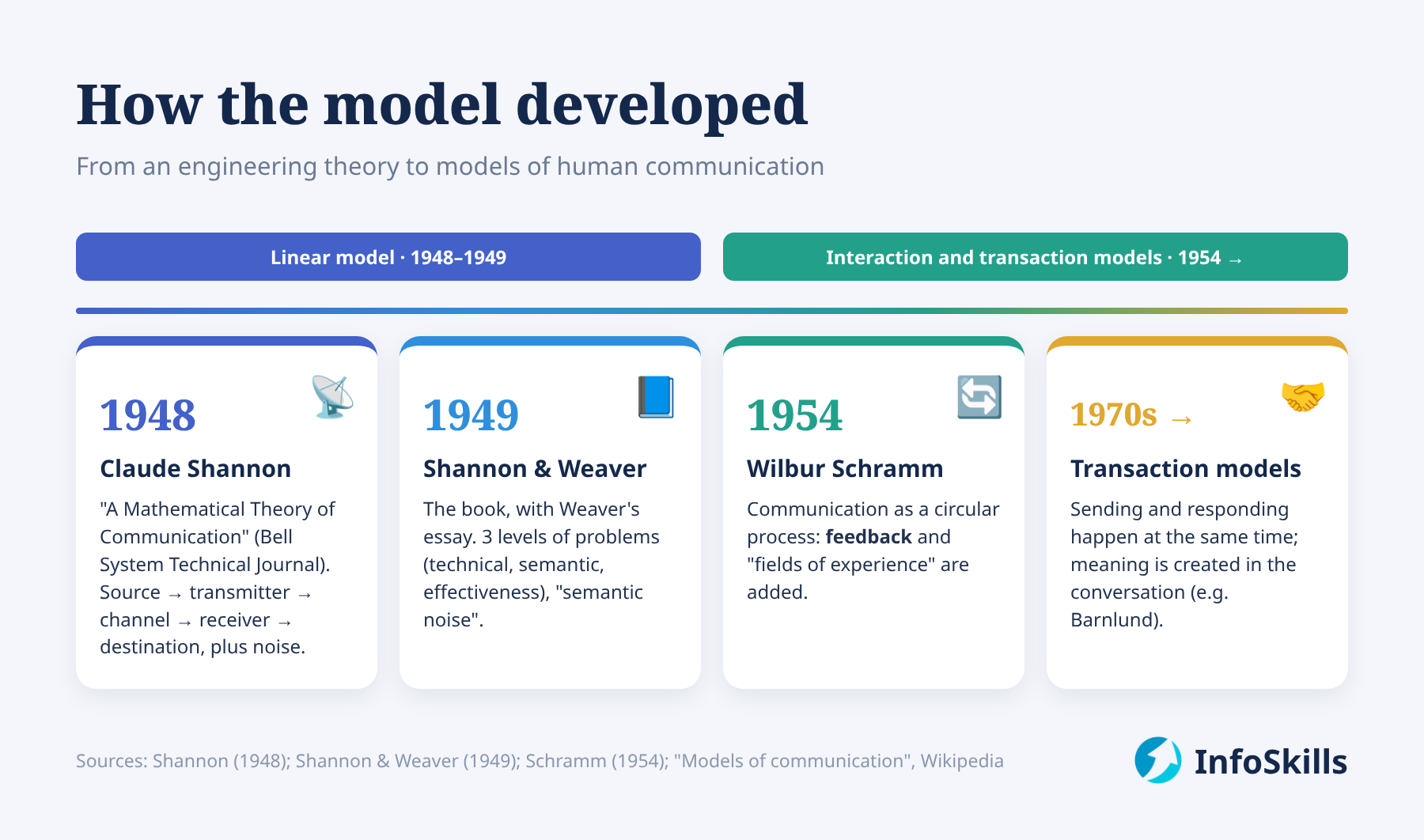
An important clarification. The original 1948–1949 model has no feedback. It is a linear, one-way model: the message goes from the source to the destination, and that is where the process ends [3][5]. A feedback loop was added later by other scholars: for example, Wilbur Schramm in 1954 described communication as a circular process in which the receiver responds with a message of their own [4]. Today many textbooks present the extended version, which is why “feedback” is often mistakenly attributed to Shannon and Weaver themselves.
The original model: 5 parts plus noise
Shannon’s “general communication system” consists of five parts, plus a source of noise [1][3]:
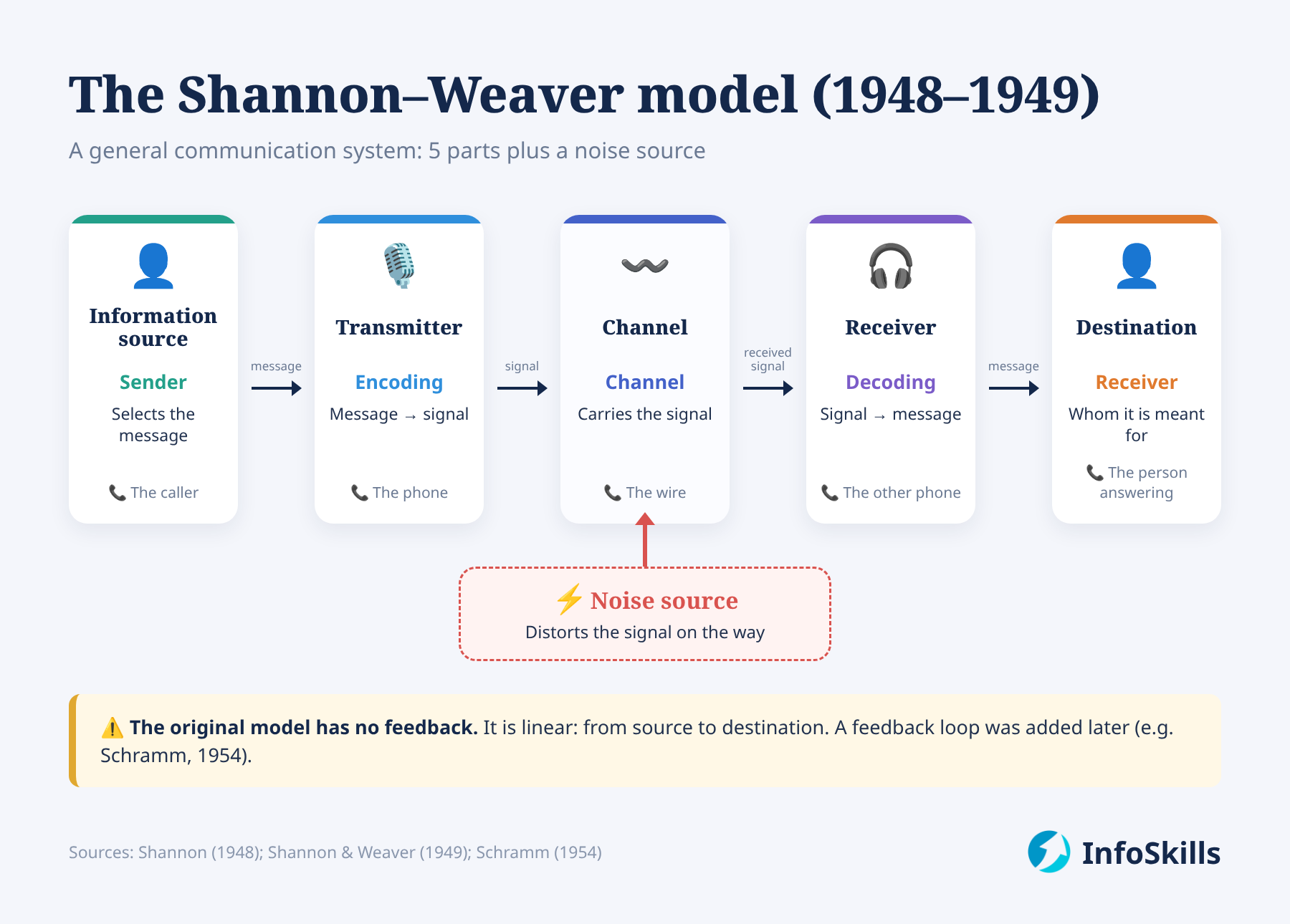
The classic example Shannon and Weaver work with is a telephone call: the person calling is the source, their phone is the transmitter, the wire is the channel, the other phone is the receiver, and the person who answers is the destination. In a face-to-face conversation the mouth is the transmitter, the air is the channel, and the ear is the receiver [3].
In today’s communication textbooks these parts are usually described in more “human” terms. That is the version we use below.
The key elements of the model
1. Sender (information source)
The person who passes on an idea. They choose what message to send.
2. Encoding (transmitter)
The sender puts their thought into words, signs or gestures. In Shannon’s terms, the transmitter turns the message into a signal that can be sent [1][3].
3. Message
The content being communicated: a sentence, a letter, an image, a figure in a report.
4. Channel
The means by which the message is carried: speech, a letter, a phone call, email, a messenger app, media [3].
5. Noise
Anything that the sender did not intend, but that distorts the message along the way [3]. More about it below.
6. Decoding (receiver)
The receiver turns the signal back into a message and interprets it in the light of their own experience and understanding [1][3].
7. Receiver (destination)
The person for whom the message was intended.
Later addition: feedback. The receiver responds, and the sender finds out whether the message was understood correctly. This element does not belong to the original model, but it is part of all its later interactive versions [4][5].
Three levels of communication problems
One of the most valuable ideas in Weaver’s essay is that communication can fail at three levels [2][3]:
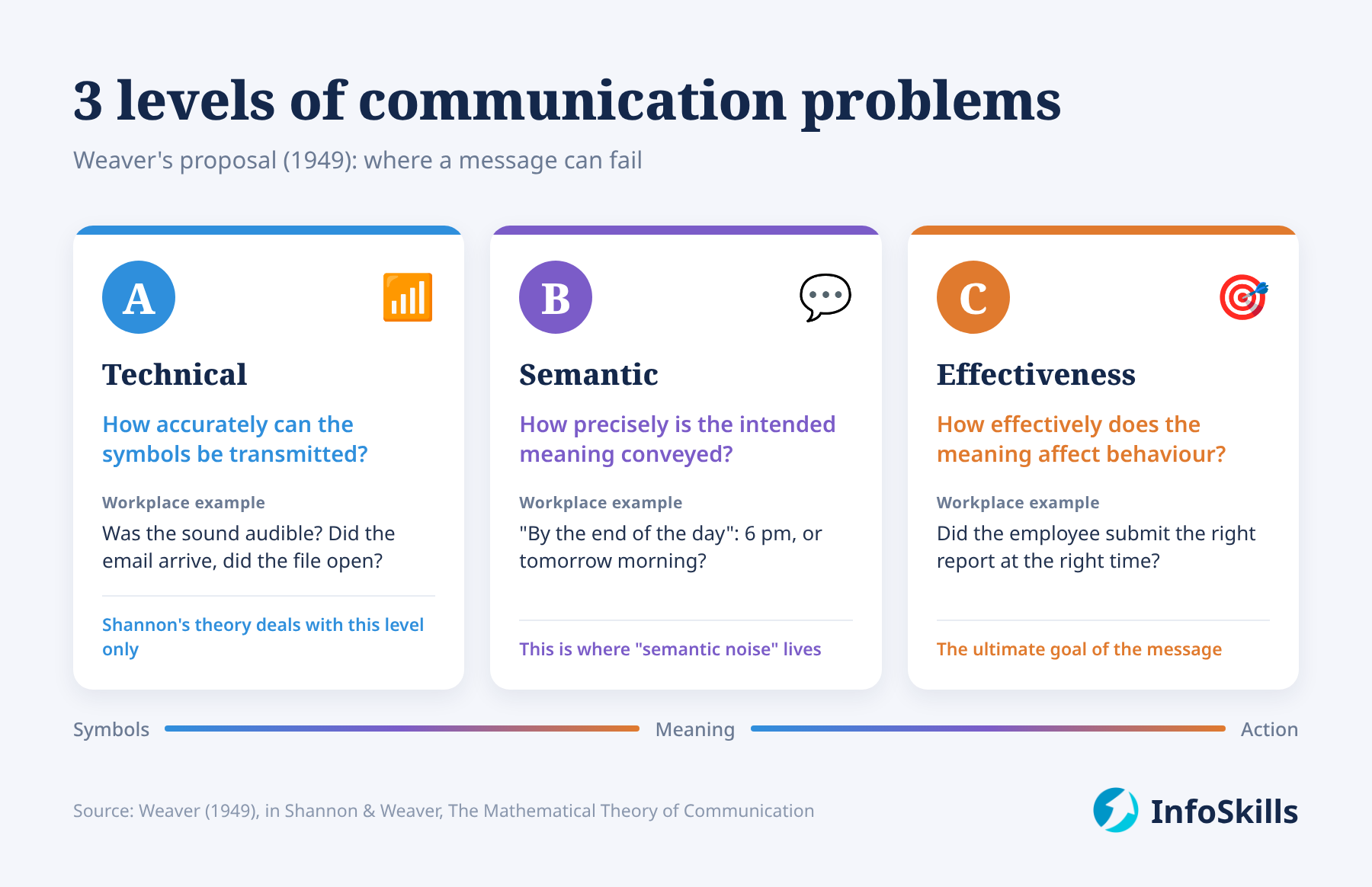
- Level A, technical: how accurately can the symbols be transmitted? (Was the sound audible? Did the file arrive?)
- Level B, semantic: how precisely do the transmitted symbols convey the intended meaning? (Was it understood the way it was meant?)
- Level C, effectiveness: how effectively does the received meaning affect behaviour in the desired way? (Did the person do what we were aiming for?)
Shannon’s mathematical theory deals with level A only: from the engineer’s point of view, the meaning of the message does not matter [1][3]. But Weaver argued that these ideas also help in thinking about levels B and C, and he suggested adding “semantic noise” and a “semantic receiver” to the diagram: distortions of meaning that come not from the wire, but from people [2].
In our opening example everything was fine at level A: the message arrived. It was at level B (“end of the day”, “the report”) and therefore at level C (the report was not delivered on time) that it broke down.
Types of noise
In communication studies, noise is any influence that interferes with the message reaching its destination [5]. Four types are usually distinguished [8]:
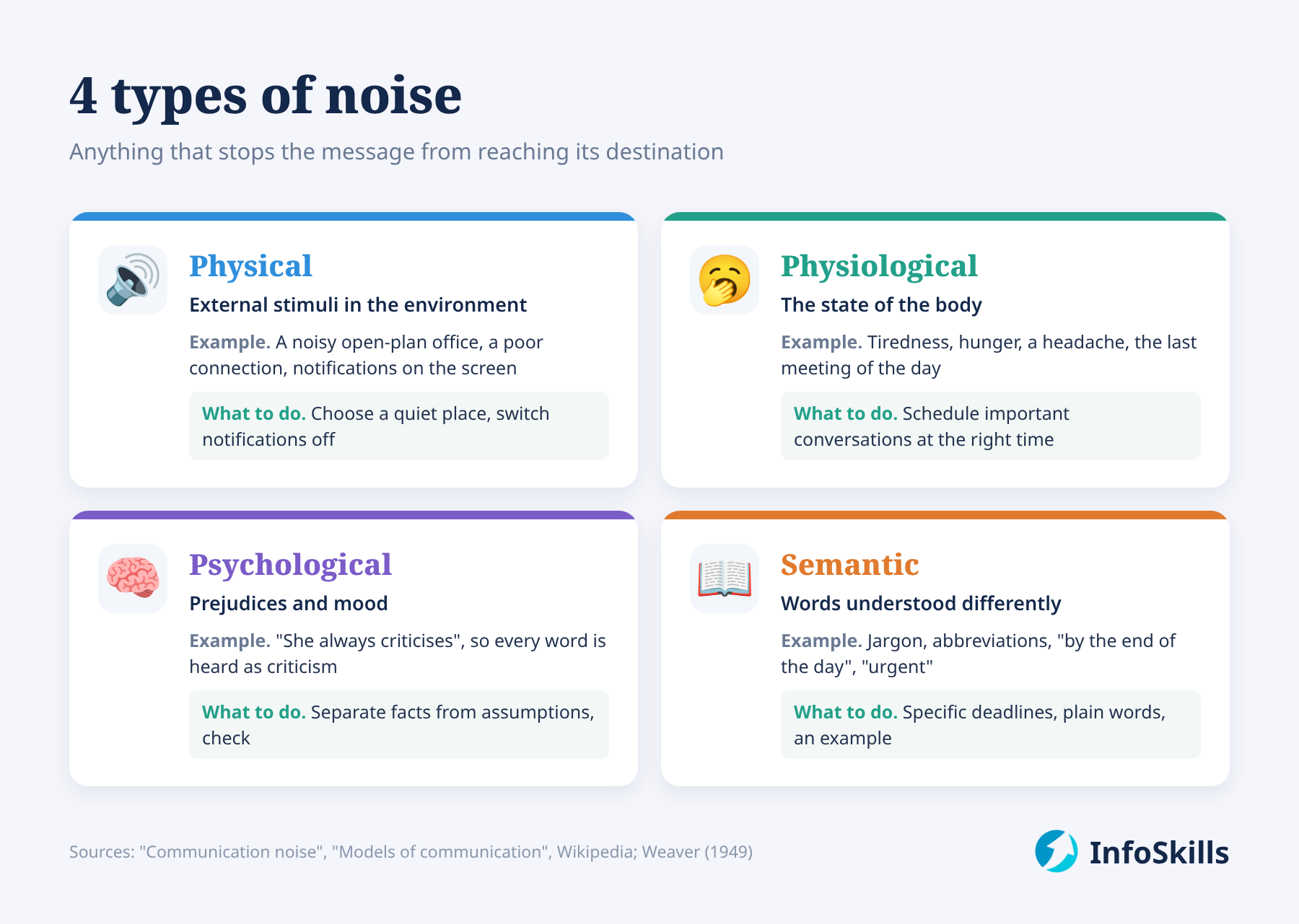
- Physical: external stimuli: a noisy open-plan office, a poor connection, notifications on the screen.
- Physiological: the state of the body: tiredness, hunger, a headache.
- Psychological: prejudices, expectations, mood, attitude towards the speaker.
- Semantic: words and terms that the receiver does not understand, or understands differently: jargon, abbreviations, ambiguous phrases like “end of the day”.
Shannon proposed a technical solution to noise: redundancy. If a message contains a little more than the bare minimum, a distortion can be detected and the original intention reconstructed [3]. In human communication this means repeating the key point, giving an example, adding a figure or a deadline: “by 6 pm today, the weekly sales report”.
Limitations of the model
The Shannon–Weaver model is called the “mother of all models” [3], but it has also been criticised:
- It is linear. Communication is presented as a one-way process, while real conversation is an exchange of messages in both directions [3][5].
- Meaning is treated as ready-made. The model assumes that the message exists before it is spoken, and that the receiver only needs to “unpack” it. Critics argue that meaning is also created in the process of communication [3].
- Context is missing. The relationship between people, culture and situation are not part of the model. Later interaction and transaction models were created to address exactly these gaps [5].
That is why the model is best used as a diagnostic tool: it helps you find where a breakdown happened, but it does not describe the whole richness of human communication.
What skills does this model develop?
- ✅ Formulating clear messages
- ✅ Precise encoding and choice of words
- ✅ Recognising noise
- ✅ Listening and decoding skills
- ✅ Preventing communication breakdowns
- ✅ Choosing the right channel
- ✅ Accurate transfer of information
- ✅ Assessing the effectiveness of communication
Why this model matters
- It gives a structured picture of communication [3].
- It helps to uncover the causes of misunderstandings.
- It has served as the basis for many later models of communication [3][4][5].
- It is well suited to organisational and technical communication: instructions, tasks, reports, emails.
Cheat sheet: how to use it tomorrow
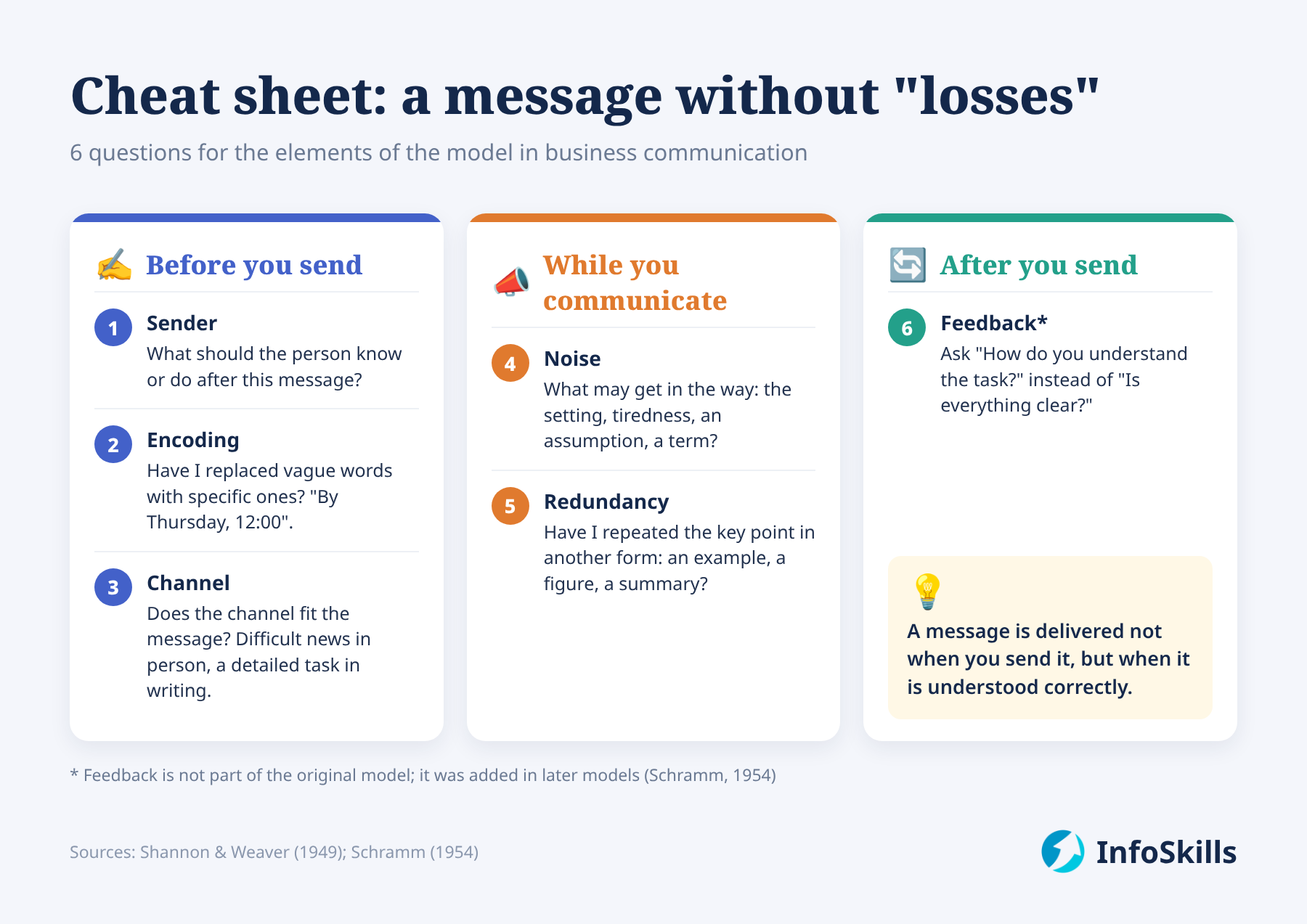
Before you send:
- Sender: what exactly do I want the person to know or do after this message?
- Encoding: have I replaced vague words with specific ones? Not “soon”, but “by Thursday at 12:00”.
- Channel: does the channel fit the message? Difficult news is better delivered in person or by phone, a detailed task in writing.
While you communicate:
- Noise: what may get in the way: the environment, tiredness, an assumption, a term? Remove whatever you can.
- Redundancy: repeat the most important point in a different form: an example, a figure, a short summary at the end.
After you send:
- Feedback: ask “How do you understand the task?” instead of “Is everything clear?”. It is not part of the original model, but in practice it is the most reliable way to check that the message arrived in the right form [4].
In summary
Communication is not just talking.
It is a transmission that can be distorted on the way.
Put your thought into clear words, reduce the noise, and check how you were understood.
Learn and practise with InfoSkills
Reading about the Shannon–Weaver model is a good start, but communication skills develop through practice.
By taking part in the InfoSkills “Effective Communication” course, you will learn and apply not only this model, but other effective tools and methods as well, which will help you express your ideas clearly and concisely, listen actively, check understanding, adapt to your audience and give constructive feedback.
In the course, every topic is reinforced through practical exercises, real-life situations and group work, so that knowledge becomes skill. And at the end, every participant leaves with a personal development and action plan.
Sources
- Shannon, C. E. (1948). A Mathematical Theory of Communication. Bell System Technical Journal, 27(3), 379–423; 27(4), 623–656. doi.org
- Shannon, C. E., & Weaver, W. (1949). The Mathematical Theory of Communication. Urbana: University of Illinois Press (includes Weaver’s essay “Recent Contributions to the Mathematical Theory of Communication”). See also: A Mathematical Theory of Communication. Wikipedia. en.wikipedia.org
- Shannon–Weaver model. Wikipedia (based on Fiske, J., Introduction to Communication Studies; Chandler, D., & Munday, R., A Dictionary of Media and Communication, and others). en.wikipedia.org
- Schramm, W. (1954). How communication works. In W. Schramm (Ed.), The Process and Effects of Mass Communication. Urbana: University of Illinois Press. See also: Schramm’s model of communication. Wikipedia. en.wikipedia.org
- Models of communication. Wikipedia. en.wikipedia.org
- Claude Shannon. Wikipedia. en.wikipedia.org
- Warren Weaver. Wikipedia. en.wikipedia.org
- Communication noise. Wikipedia. en.wikipedia.org
Course: Effective Communication
© 2026 InfoSkills, Varuzhan Avanesyan. Reuse only with the author's permission and a link to the source.


















No comments yet. Be the first.