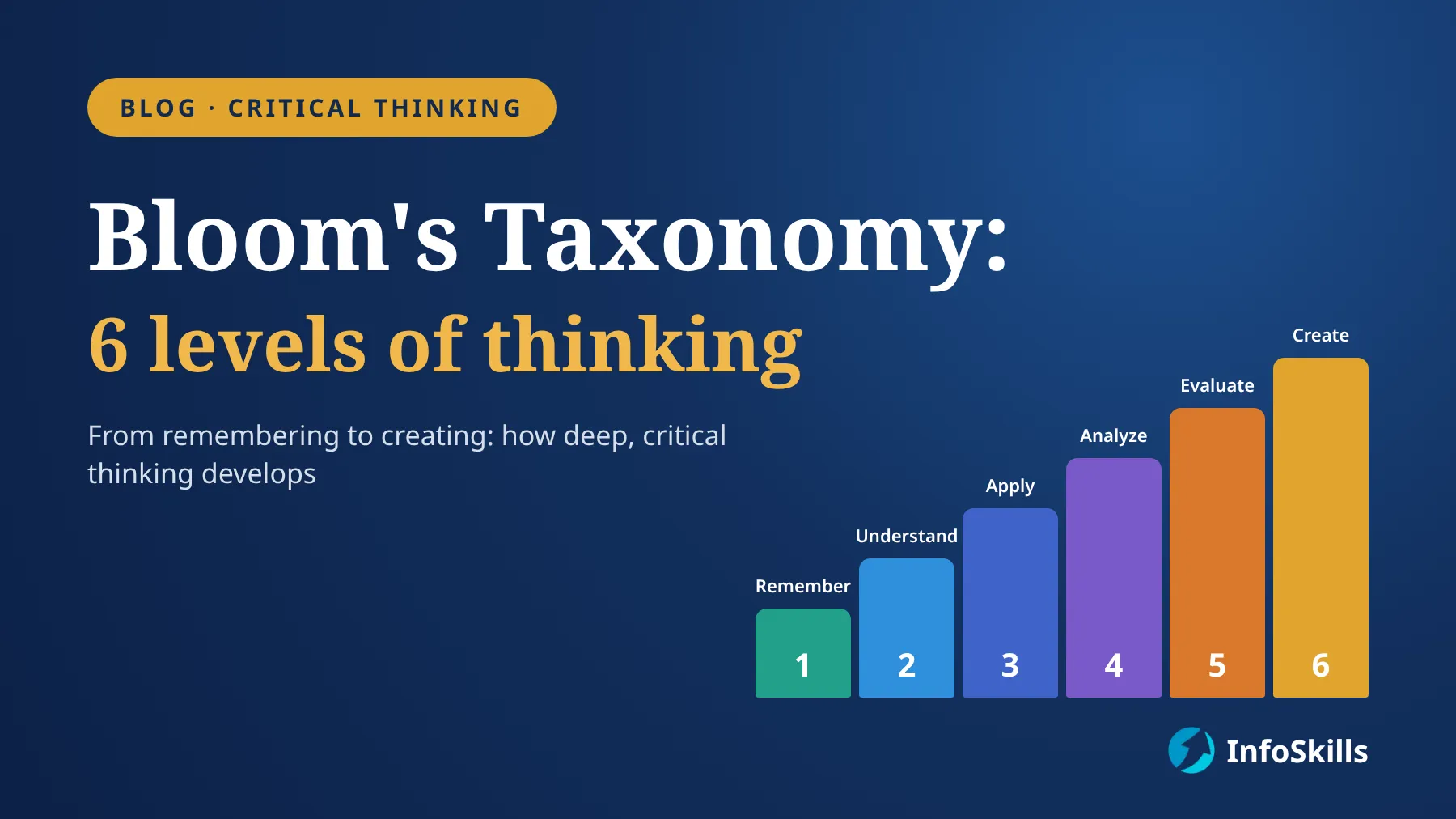
Bloom's Taxonomy: 6 levels of thinking, from remembering to creating
Knowing a definition by heart and using it to create a new solution are two very different levels of thinking. We look at Bloom's revised taxonomy: the 6 levels of thinking, where they came from, what research says, examples, and a practical cheat sheet for trainers and managers.

After a training session, two participants take the same test. Both answer every question correctly. A week later, the first can repeat the definition of “constructive feedback” word for word, but stays silent in a real conversation with a colleague. The second does not remember the exact wording, but prepares the conversation, picks the right moment and says the right words.
Who learned better? The answer depends on what level of thinking we were aiming for. The test checked memory. Work requires application, analysis and judgement.
In this article we look at one of the best-known models in education, Bloom’s Taxonomy, in its revised form: what the 6 levels of thinking are, where the model came from, what changed in 2001, what research says, and how trainers, managers and learners can use it starting tomorrow.
What is Bloom’s Taxonomy?
In one sentence: Bloom’s revised taxonomy describes 6 levels of thinking, from remembering to creating, and shows how deep, critical thinking develops.
Its central idea is simple: thinking has levels. Not all “knowing” is equally deep.
Remembering a piece of information is one thing. Analysing it, judging it, or creating something new from it is a completely different level. Bloom’s model shows how thinking grows step by step, and gives teachers, trainers and managers a shared language for talking about it.
The word “taxonomy” means a classification. Bloom and his colleagues did not set out to create a theory of intelligence: they wanted a common language about learning goals that would make communication easier across people, subjects and grade levels [3].
Where it came from
The idea was born in 1948, at an informal meeting of college examiners during the American Psychological Association convention in Boston [3]. They wanted a common framework for describing what students are expected to learn, so that they could share test items and compare results.
In 1956 the work was published as Taxonomy of Educational Objectives, Handbook I: Cognitive Domain, edited by Benjamin S. Bloom with M. D. Engelhart, E. J. Furst, W. H. Hill and D. R. Krathwohl [1]. Bloom (1913–1999) was an educational psychologist at the University of Chicago [5], and the model became known by his name.
The original taxonomy had six categories, written as nouns: Knowledge, Comprehension, Application, Analysis, Synthesis, Evaluation [1][3].
Almost half a century later, in 2001, a group led by Lorin Anderson and David Krathwohl (one of the original authors) published a revised version: A Taxonomy for Learning, Teaching, and Assessing [2][3].
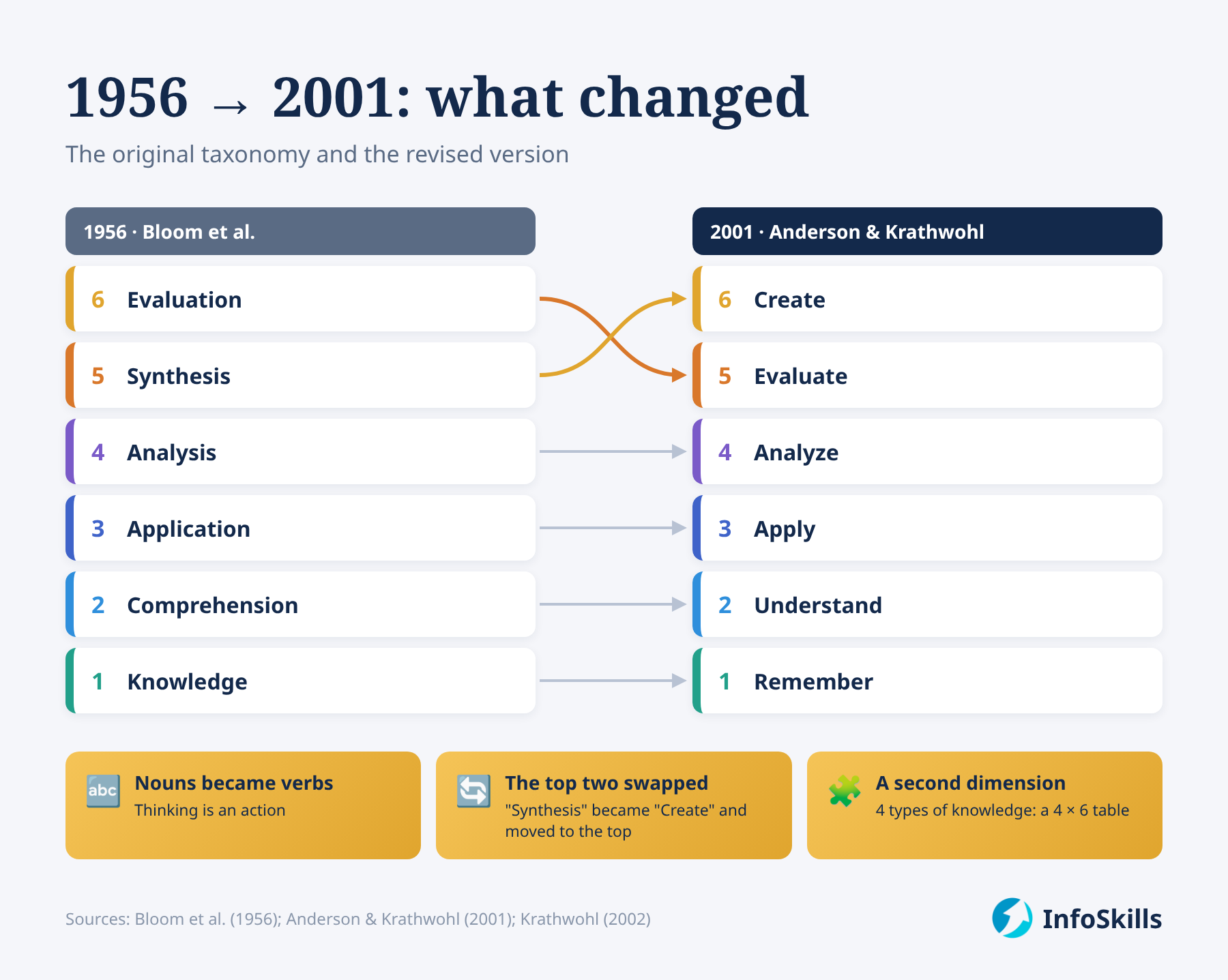
The revision made three important changes [2][3]:
- Nouns became verbs. Thinking is an action, so the levels are now remember, understand, apply, analyse, evaluate, create.
- “Knowledge” became “Remember”, “Comprehension” became “Understand”.
- The top two levels swapped places. “Synthesis” was renamed Create and moved to the very top, while Evaluate became the fifth level.
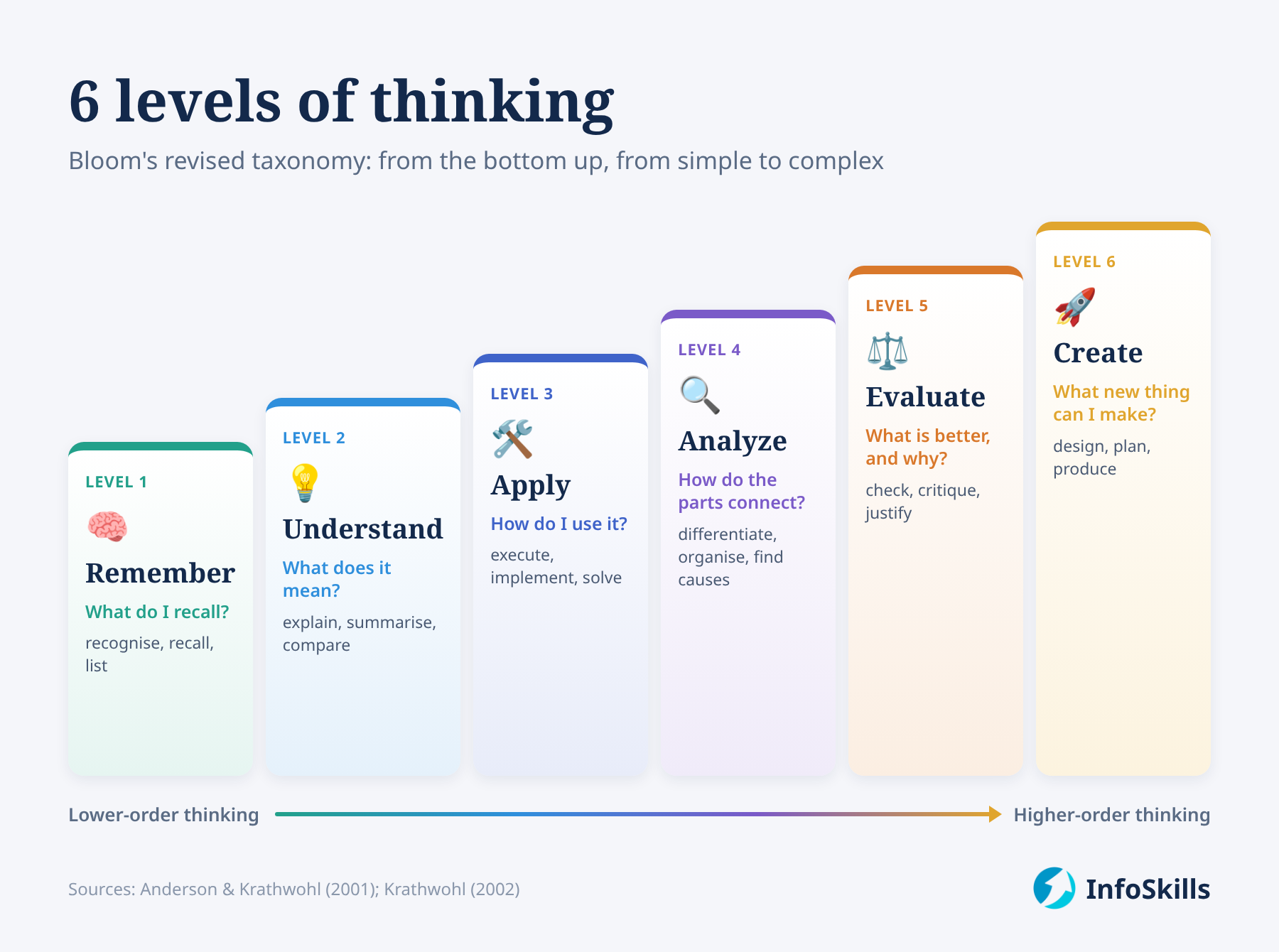
The 6 levels of thinking (from the bottom up)
1. Remember
Recall and reproduce information. Example: give the definition of a term, list the stages of a process.
2. Understand
Explain an idea in your own words and show that you have grasped its meaning. Example: explain a concept with your own example, summarise a text.
3. Apply
Use knowledge in a real situation. Example: apply a theory to a practical problem, use a template to prepare a real report.
4. Analyze
Break an idea into parts and understand how they are connected. Example: find cause-and-effect links, separate facts from opinions.
5. Evaluate
Make a well-reasoned judgement based on criteria. Example: compare several options and choose the best one, with arguments.
6. Create
Put elements together into something new: an idea, a model, a plan or a solution. Example: design a new process, write a project, propose an original solution.
According to the model, this is the highest and most complex level of thinking.
The second dimension: what kind of knowledge?
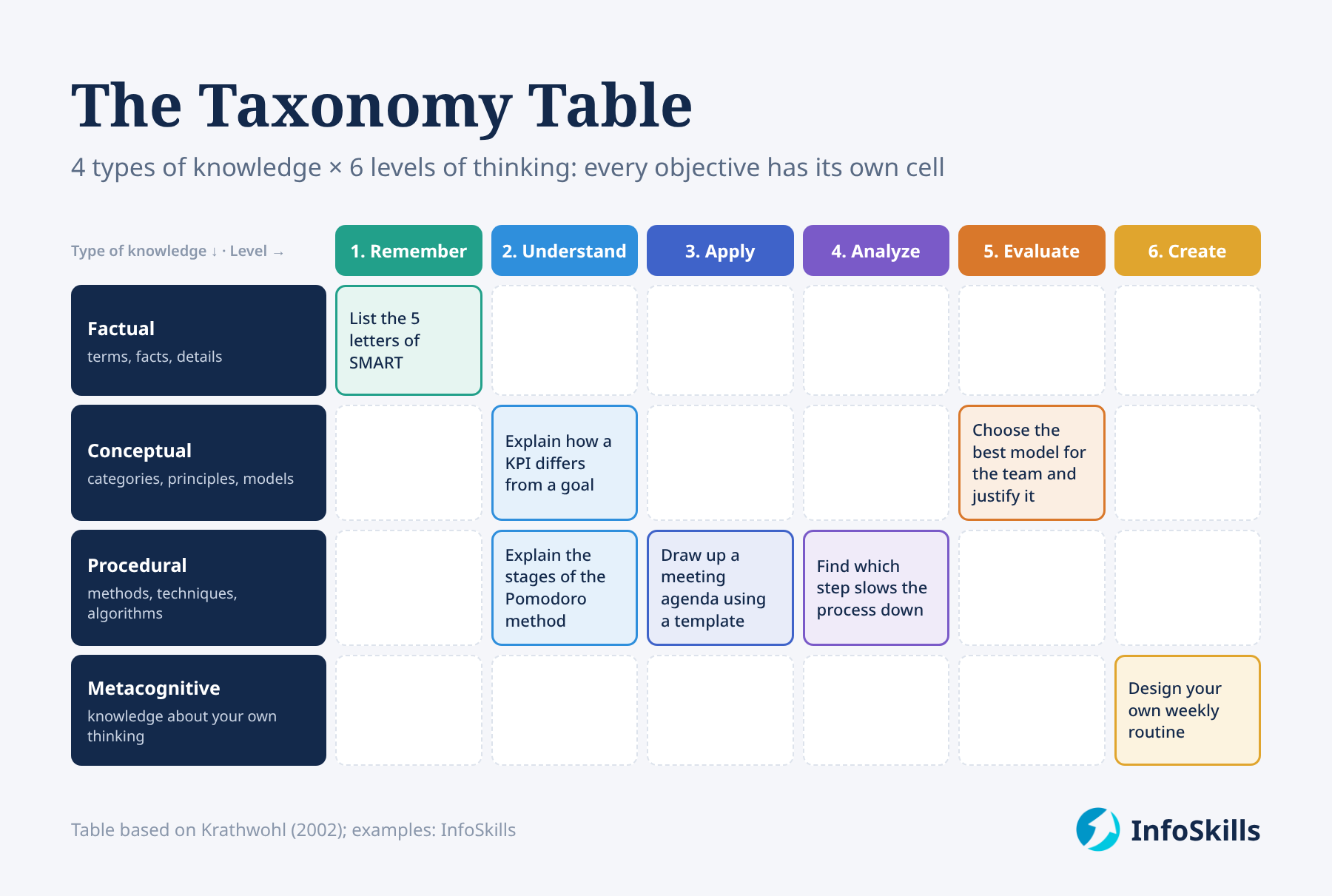
The revision added something that is often forgotten: a second axis, the knowledge dimension [3]. It describes what we think about, while the 6 levels describe how we think:
- Factual knowledge: the basic elements of a field: terms, facts, details.
- Conceptual knowledge: categories, principles, theories and models, and how they fit together.
- Procedural knowledge: how to do something: methods, techniques, algorithms.
- Metacognitive knowledge: knowledge about thinking itself, including awareness of one’s own thinking and learning.
Together they form a Taxonomy Table of 4 × 6 = 24 cells [3]. Any learning objective can be placed in it: for example, “explain the stages of the Pomodoro method” is understand + procedural, while “design your own weekly routine based on how you work best” is create + metacognitive.
Is it a strict ladder?
The model is often drawn as a pyramid or a staircase, and it is easy to conclude that you must “finish” one level before you may move to the next. The authors of the revision softened this idea: the levels are still ordered from simpler to more complex, but the hierarchy is less rigid, and the categories can overlap [3].
Research supports this. In 2019 Pooja Agarwal published three experiments, two with college students in the laboratory and one in a real 6th-grade classroom [4]. The question was: do students first need to memorise facts before they can learn at higher levels?
The results [4]:
- fact quizzes improved performance on fact tests, but did not improve higher-order performance;
- higher-order and mixed quizzes improved higher-order performance;
- mixed practice (fact and higher-order questions together) gave the best results overall.
The practical lesson: facts matter, but remembering facts does not automatically turn into analysis, judgement or creativity. If we want higher-level thinking, we need to practise it from the start, together with the facts.
A simple example: one topic, six levels
Take a topic from a management course, feedback. Here is what the task looks like at each level:
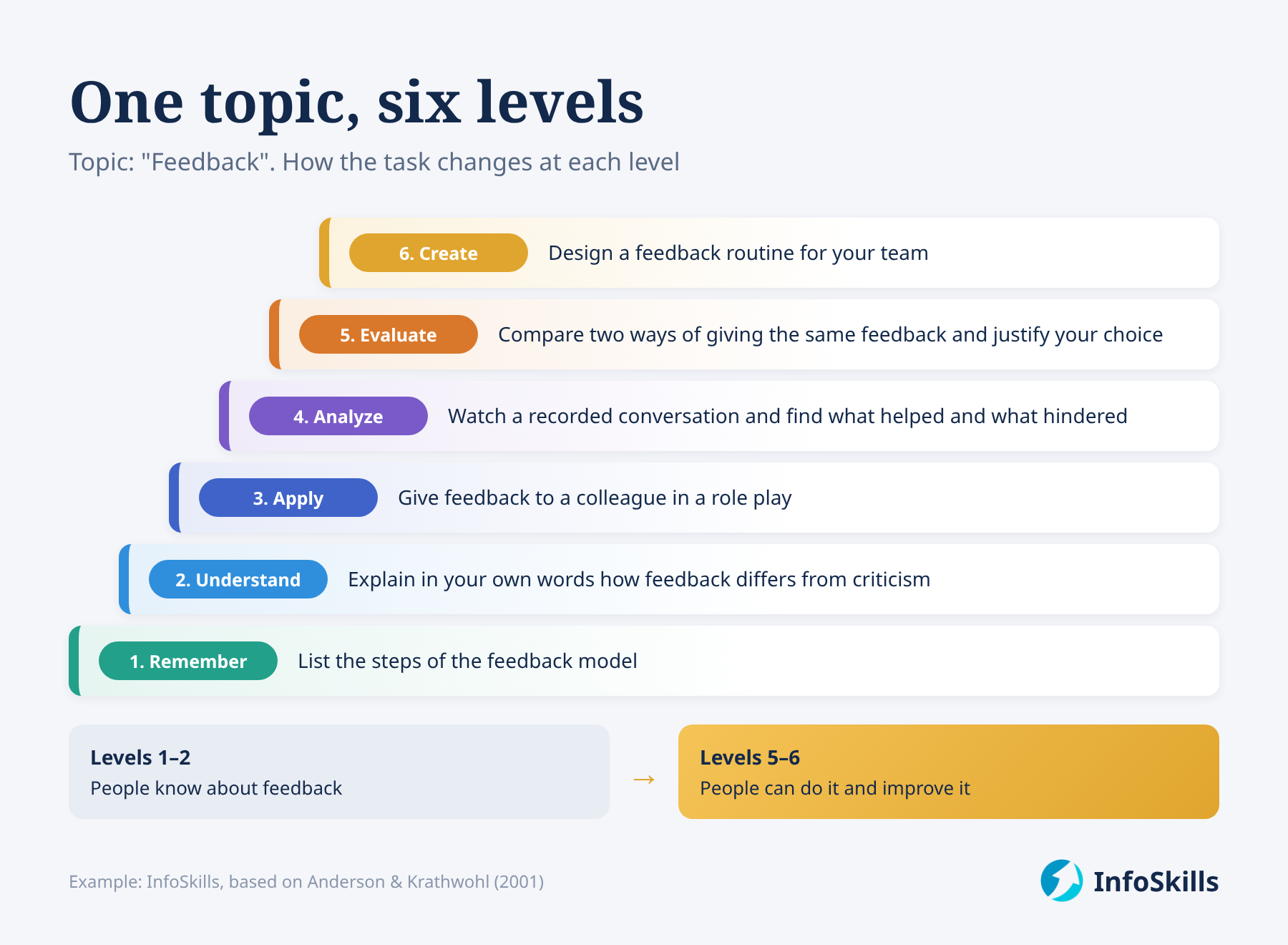
- Remember: list the steps of the feedback model.
- Understand: explain in your own words how feedback differs from criticism.
- Apply: give feedback to a colleague in a role play.
- Analyse: watch a recorded conversation and find what helped and what hindered.
- Evaluate: compare two ways of giving the same feedback and justify which one is better.
- Create: design a feedback routine for your team.
A course that stops at the first two levels produces people who know about feedback. A course that reaches the top produces people who can do it and improve it.
What skills does this model develop?
- ✅ Step-by-step development of thinking
- ✅ Deeper understanding of information
- ✅ Analytical thinking
- ✅ Well-reasoned judgement
- ✅ Creative thinking
- ✅ Applying knowledge in practice
- ✅ Better-quality decisions
- ✅ Intellectual independence
Why it matters
- It helps to design learning objectives, courses and assessment systems that match each other [2][3].
- It shows the path along which thinking develops.
- It is used in schools, universities, corporate training, and in developing managers and teams.
- It supports solving complex, higher-level problems.
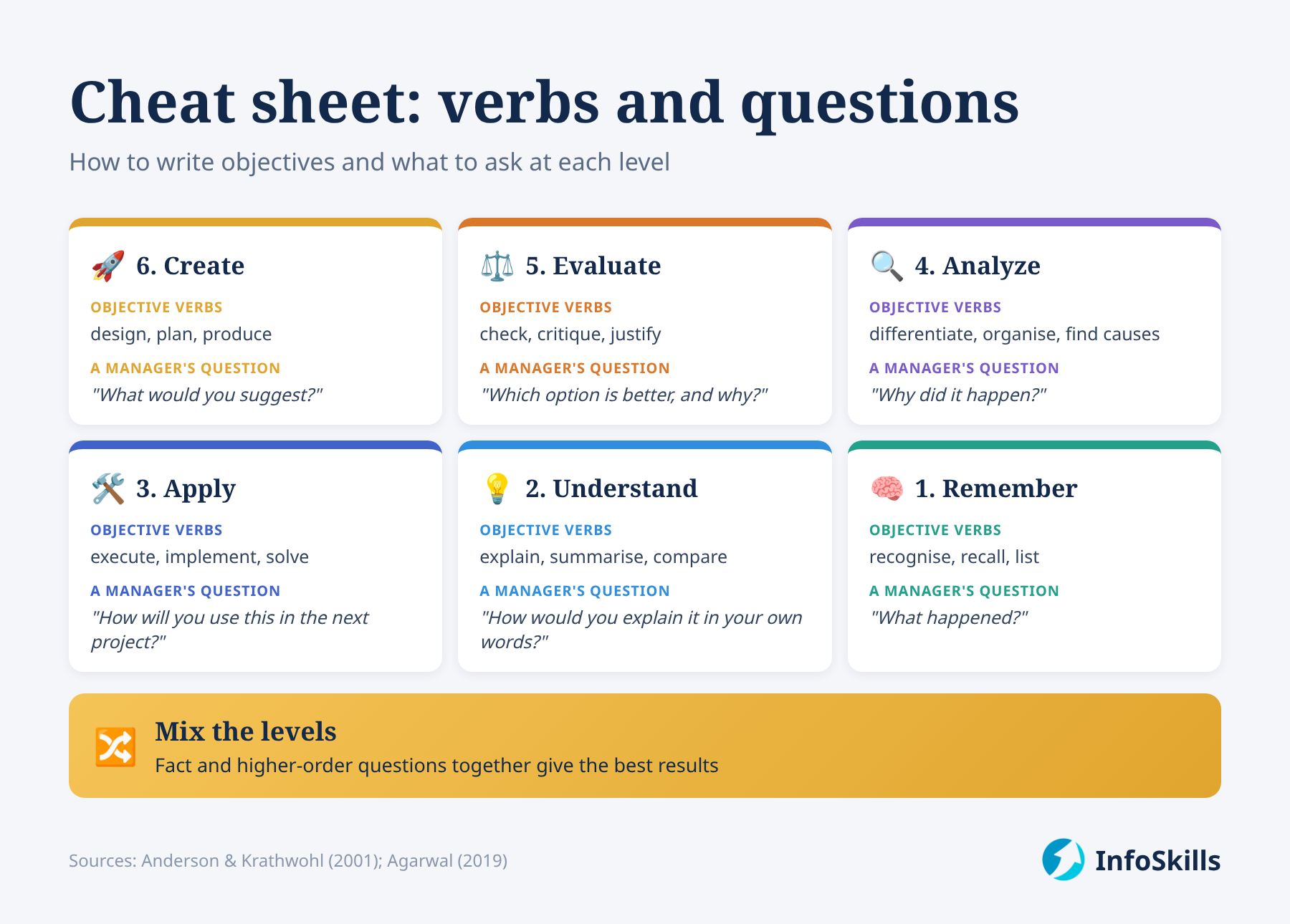
Cheat sheet: how to use it tomorrow
For trainers and teachers:
- Write the objective with a verb from the right level. Not “participants will know about feedback”, but “participants will be able to give feedback using the model” (apply).
- Check that the task matches the objective. If the goal is “evaluate”, a multiple-choice question about definitions is not enough.
- Mix the levels in every exercise and quiz, as Agarwal’s research suggests [4].
For managers:
- Ask questions from higher levels. Not only “What happened?” (remember), but also “Why did it happen?” (analyse), “Which option is better and why?” (evaluate) and “What would you suggest?” (create).
- Delegate tasks that grow thinking. Give people the chance to analyse, judge and create, not only to execute.
In summary
Critical thinking begins with remembering, but it ends with creating. Facts are the foundation, yet real growth happens at the upper levels: where we analyse, judge and create something new.
Don’t stop at “I know”. Move on to “I can”, “I can judge” and “I can create”.
Learn and practise with InfoSkills
Reading about Bloom’s taxonomy is a good start, but thinking develops through practice.
By taking part in the InfoSkills “Critical Thinking” course, you will learn and apply not only this model, but other effective tools and methods as well, which will help you analyse information, question assumptions, evaluate sources and arguments, and make well-reasoned decisions.
In the course, every topic is reinforced through practical exercises, real-life situations and group work, so that knowledge becomes skill. And at the end, every participant leaves with a personal development and action plan.
Sources
- Bloom, B. S. (Ed.), Engelhart, M. D., Furst, E. J., Hill, W. H., & Krathwohl, D. R. (1956). Taxonomy of Educational Objectives: The Classification of Educational Goals. Handbook I: Cognitive Domain. New York: David McKay. archive.org
- Anderson, L. W., & Krathwohl, D. R. (Eds.). (2001). A Taxonomy for Learning, Teaching, and Assessing: A Revision of Bloom’s Taxonomy of Educational Objectives. New York: Longman. See also: Bloom’s taxonomy. Wikipedia. en.wikipedia.org
- Krathwohl, D. R. (2002). A Revision of Bloom’s Taxonomy: An Overview. Theory Into Practice, 41(4), 212–218. doi.org
- Agarwal, P. K. (2019). Retrieval practice & Bloom’s taxonomy: Do students need fact knowledge before higher order learning? Journal of Educational Psychology, 111(2), 189–209. doi.org
- University of Chicago Chronicle (1999, September 23). Obituary: Benjamin Bloom, Charles H. Swift Distinguished Service Professor Emeritus in Education. chronicle.uchicago.edu
Course: Critical Thinking
© 2026 InfoSkills, Varuzhan Avanesyan. Reuse only with the author's permission and a link to the source.


















No comments yet. Be the first.