
SMART + KPI: how to turn measurable goals into accountable results
After "We need to work well this month", nobody can say whether the goal was reached. We look at the accountability model built on SMART goals and KPIs: the science behind it, examples, the pitfalls to avoid and a practical cheat sheet.


Monday morning, a team meeting. The manager sums up: “This month we need to work well and pay more attention to our customers.” Everyone nods. A month later, at the next meeting, the question is: did we succeed? One person thinks yes, another thinks no, a third says “we did our best”. Nobody can prove anything, because nobody knows what “well” meant.
That is not a problem of discipline. It is a problem of how the goal was set. It is hard to hold anyone accountable when the goals are vague, because there is nothing to report against.
In this article we look at one of the most practical accountability models, the one built on SMART goals and KPIs: what it consists of, where it came from, why it works, what traps to avoid, and how to apply it in your team starting tomorrow.
What is the SMART + KPI model?
In one sentence: this model ensures responsibility and results-focused management through clearly worded SMART goals and measurable KPIs (Key Performance Indicators).
Its central idea is simple: accountability needs measurable goals.
In plain language, the model says:
- 👉 set a clear goal,
- 👉 measure it with concrete indicators,
- 👉 track progress regularly,
- 👉 ask for, and give, an account of the results.
When everything is measurable, there is less room for excuses, and more room for honest conversation.
The 4 building blocks of the model
The model has four parts that work as one cycle:
- SMART goals: what exactly we want to achieve, by when, and who is responsible.
- KPIs: the indicators that show whether we are moving towards the goal.
- Regular review: a fixed rhythm for looking at the numbers.
- Feedback: a conversation about what the numbers mean and what we do next.
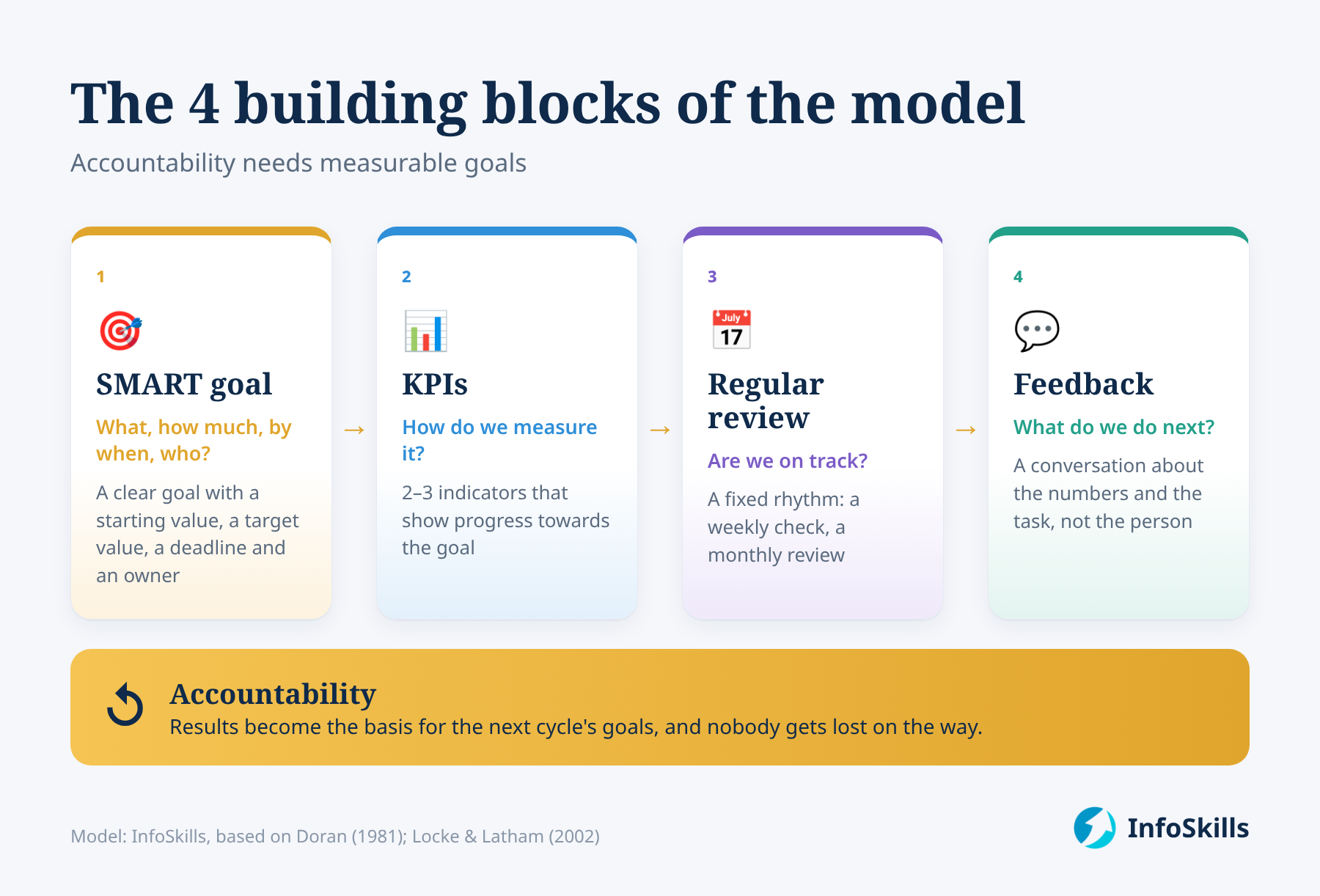
If even one block is missing, the system breaks. A goal without a KPI is a wish. A KPI without review is a forgotten number. Review without feedback becomes a control ritual that nobody learns from.
Part 1. SMART goals
The SMART acronym was introduced in 1981 by George T. Doran, in a short article in the journal Management Review titled “There’s a S.M.A.R.T. way to write management’s goals and objectives” [1].
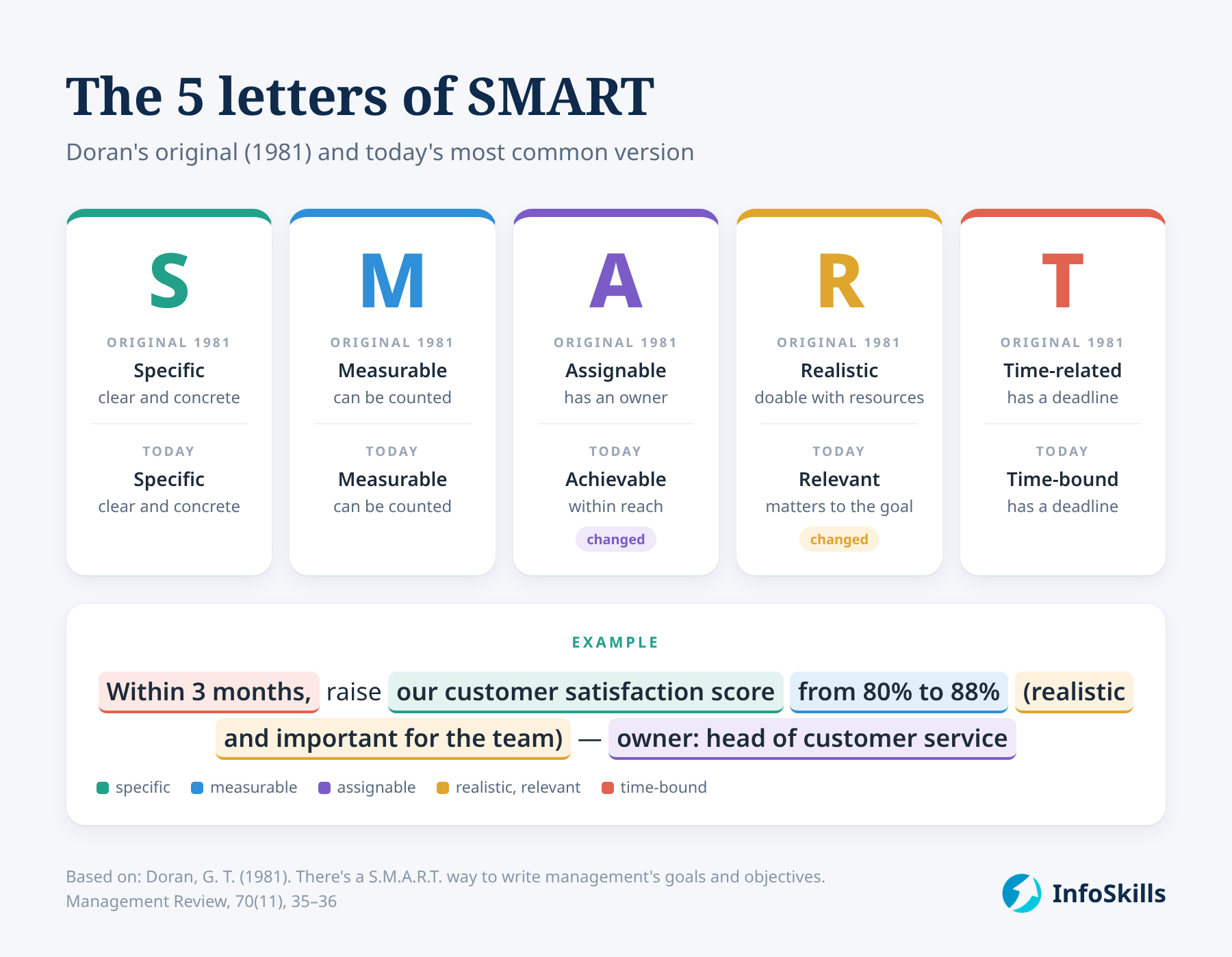
Interestingly, Doran’s original version is not quite the one most people know today [1]:
- S, M: Specific and Measurable are the same in both versions.
- A: in the original it is Assignable, meaning it is clear who will do the work; today it is usually Achievable.
- R: in the original it is Realistic; today it is usually Relevant.
- T: in the original it is Time-related; today it is usually Time-bound.
The original “A for Assignable” matters a great deal for accountability: a goal that does not say who is responsible will most likely remain nobody’s goal. That is why, when we write a goal, we recommend combining both versions: a good goal is specific, measurable, achievable, relevant, time-bound and has a named owner.
Doran himself also pointed out that not every objective can be quantified, especially at middle-management levels [1]. SMART is a tool for writing clearly, not a rigid law.
✅ Example. Not “improve customer satisfaction”, but: “Within 3 months, raise our customer satisfaction score from 80% to 88% (owner: head of customer service).”
Notice the detail: “raise by 10%” can be read in two ways (by 10 percentage points or by 10 percent). Writing the starting and target values, “from 80% to 88%”, removes the ambiguity.
Part 2. KPIs: Key Performance Indicators
A KPI is a type of performance measurement used to evaluate how successfully an organization, activity, project or process is achieving its defined objectives [5]. KPIs can track operational targets such as quality, efficiency or customer satisfaction, as well as progress towards strategic goals [5].
Common examples:
- sales volume,
- customer retention rate,
- productivity,
- on-time delivery rate.
The easiest way to see the difference between a goal and a KPI is a car journey: the SMART goal is the destination and the arrival time, the KPI is the dashboard: speed, fuel, distance travelled. You cannot get there without the destination, and you cannot know whether you will get there on time without the dashboard.
Why measurable goals work: what research says
The SMART + KPI model is not just management folklore. It rests on several well-studied findings.
1. Specific goals beat “do your best”. Edwin Locke and Gary Latham summarized 35 years of research on goal setting and concluded that specific, difficult goals lead to higher performance than easy goals or a vague instruction to “do your best” [2]. “Do your best” has no external reference point, so everyone interprets it in their own way. They also found that goals work best together with feedback that shows progress towards them [2].
2. Tracking progress helps achieve the goal. A meta-analysis by Benjamin Harkin and colleagues covered 138 studies with 19,951 participants [3]. Interventions that prompted people to monitor their progress increased goal attainment. The effect was larger when the progress was reported or made public and when it was physically recorded [3]. This is exactly what an accountability system does: it records progress and makes it visible.
3. Feedback helps, but not always. Avraham Kluger and Angelo DeNisi analysed 607 effect sizes from feedback studies [4]. On average, feedback improved performance, but in more than a third of cases it actually lowered performance [4]. According to their analysis, feedback works worse when it shifts a person’s attention from the task to themselves (“you’re a bad employee”) instead of to the task (“this indicator fell, let’s understand why”).
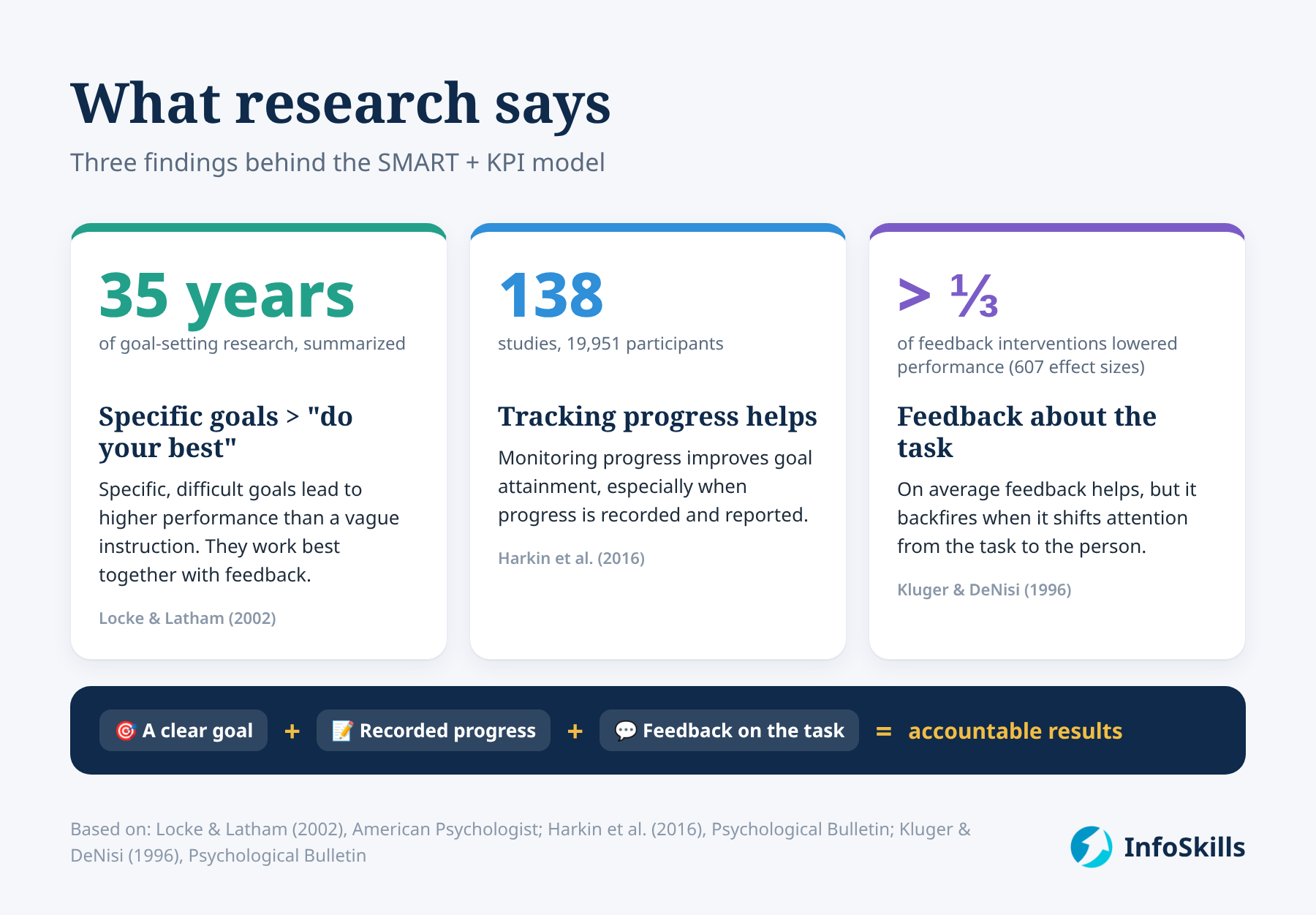
The practical conclusion: clear goals and regular measurement increase the chance of success, and feedback should be about the task and the numbers, not about the person.
Part 3 and 4. Regular review and feedback
Measurement is useful only when someone looks at the numbers regularly and draws conclusions from them. A simple rhythm that works in most teams:
- Weekly, 15 minutes: a quick look at 2–3 key KPIs. Are we on track? Is anything blocking us?
- Monthly, 1 hour: a review of results against the SMART goals. What worked, what didn’t, what will we change?
- Quarterly: a review of the goals and KPIs themselves. Are we measuring the right things?
Feedback in this model is a two-way conversation: the manager asks for an account, and the employee gets support, resources and recognition. Accountability is not a hunt for someone to blame; it is a shared look at reality.
Caution: when the number becomes the goal
There is a well-known warning that every manager who works with KPIs should know. In 1975 the British economist Charles Goodhart noticed that statistical indicators tend to lose their reliability once they are used as targets for control. In 1997 the anthropologist Marilyn Strathern summarized the idea in the widely quoted form: “When a measure becomes a target, it ceases to be a good measure” [7].
One of the best-known examples is the US bank Wells Fargo. On 8 September 2016 the US Consumer Financial Protection Bureau (CFPB) fined the bank $100 million: to meet sales targets, employees had opened more than 2 million deposit and credit card accounts that customers may not have authorized [6]. The CFPB linked the practice to the bank’s incentive compensation programme and sales targets; together with other regulators’ penalties, the bank paid $185 million in fines [6].
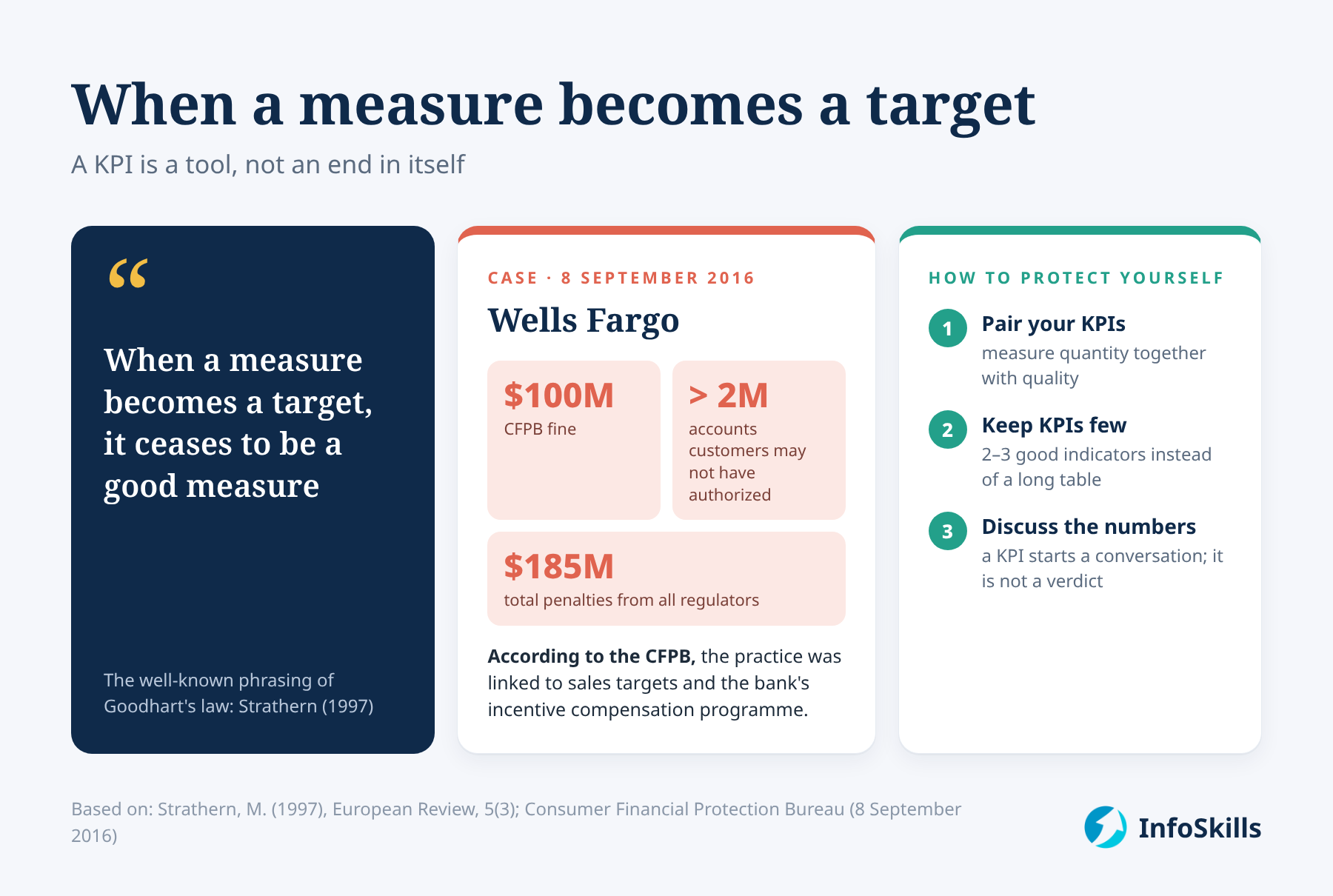
How to protect yourself from this trap:
- Pair the KPIs. Measure quantity together with quality: not only “the number of new contracts”, but also “the share of customers who stay after 6 months”.
- Keep KPIs few. A small number of well-chosen indicators beats a long table that nobody reads.
- Discuss the numbers, don’t just reward or punish them. A KPI is a reason for a conversation, not a final verdict.
What this model develops
In individuals and teams, the SMART + KPI model develops:
- ✅ clarity in goal setting,
- ✅ time management,
- ✅ measuring results,
- ✅ discipline,
- ✅ results-oriented thinking,
- ✅ transparency,
- ✅ an accountability culture and structured management.
Why it matters
- It creates a measurable and controllable system.
- It reduces subjective evaluation: “I think” gives way to “the data shows”.
- It strengthens team discipline, because everyone knows what they are accountable for.
- It helps detect problems early, when they are still small.
- It is widely used in project management, performance management and personal development [1][5].
📌 Best suited for: business and project management, as well as any team that wants to manage by results.
A simple example
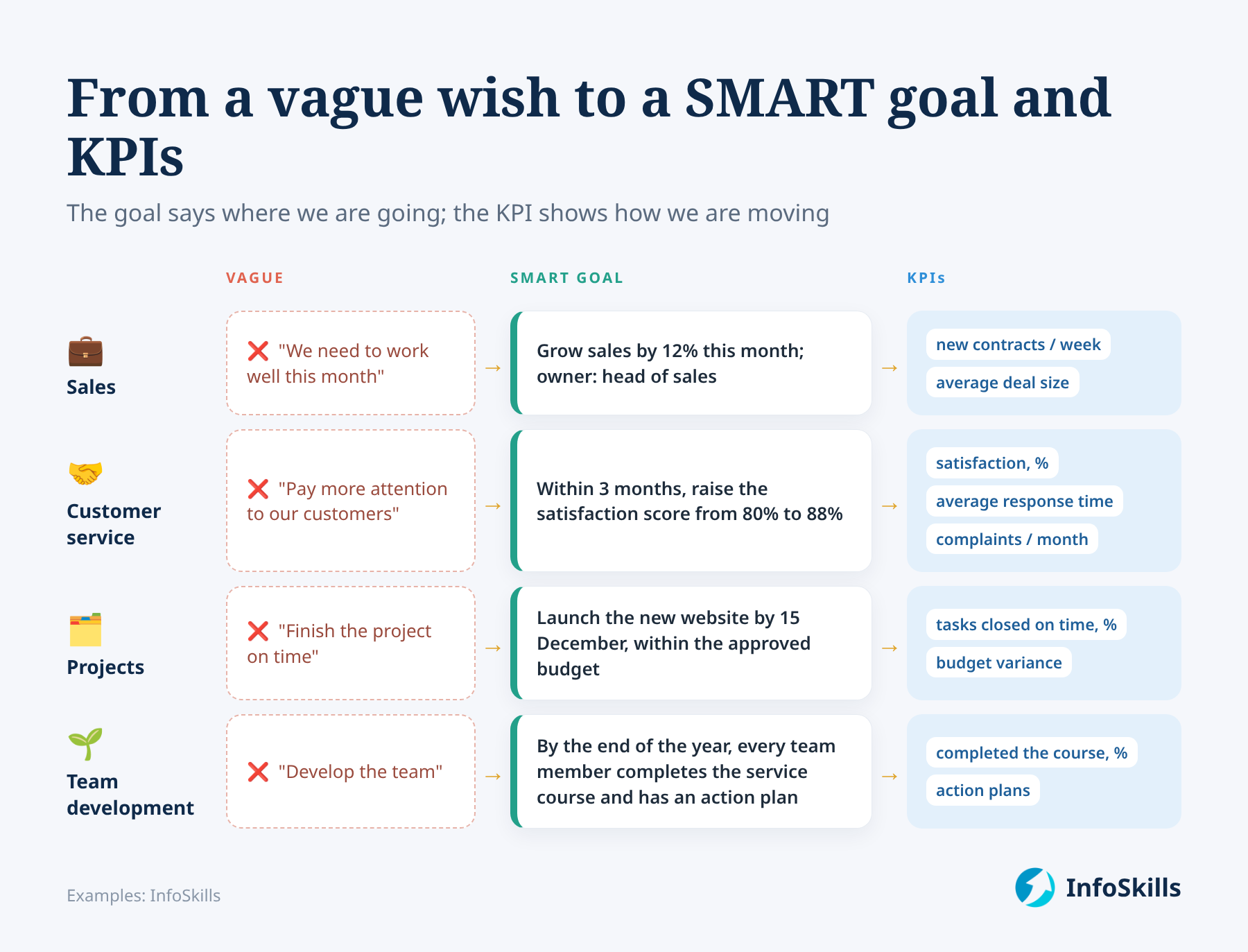
❌ “We need to work well this month.”
✅ “This month sales must grow by 12%; the KPI is the number of new contracts, which we check every Monday.”
In the second version, both the goal and the way of measuring it are clear. Accountability becomes possible.
A cheat sheet: 5 steps to start tomorrow
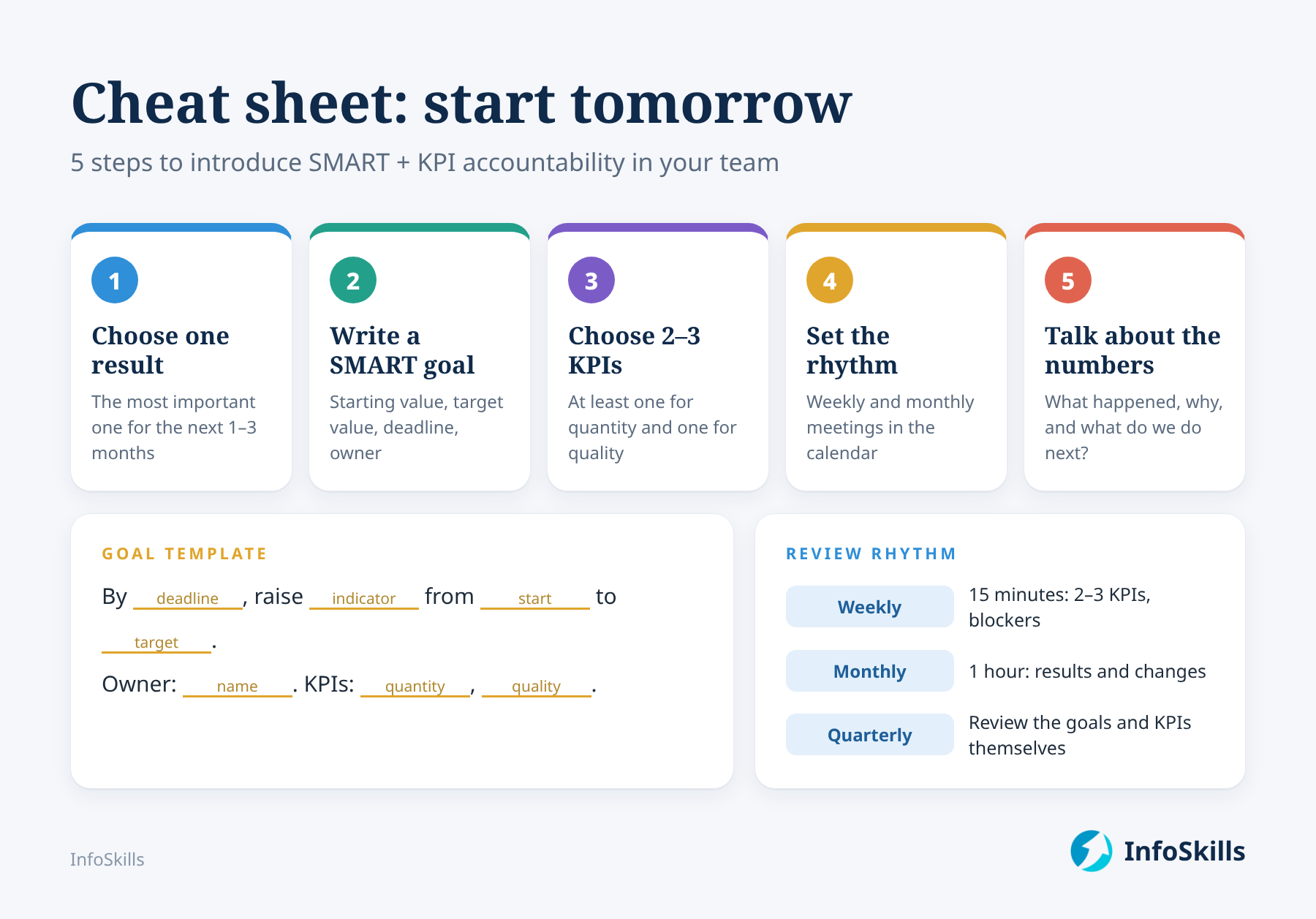
- Choose one important result for the coming 1–3 months.
- Write it as a SMART goal, with a starting value, a target value, a deadline and an owner.
- Choose 2–3 KPIs: at least one for quantity and one for quality.
- Set the review rhythm in the calendar: weekly 15 minutes, monthly 1 hour.
- Talk about the numbers, not about people: what happened, why, and what we will do next.
In summary
Accountability grows stronger where goals are clear and results are measurable. SMART goals say where we are going, KPIs show how we are moving, and regular review and feedback make sure nobody gets lost on the way.
A measurable goal = an accountable result.
Learn and practise with InfoSkills
Reading about the SMART + KPI model is a good start, but real change begins with practice.
By taking part in the InfoSkills “Accountability” course, you will learn and apply not only this tool, but other effective tools and methods as well, which will help you define commitments clearly, keep promises, report on time and build a culture of responsibility in your team.
In the course, every topic is reinforced through practical exercises, real-life situations and group work, so that knowledge becomes skill. And at the end, every participant leaves with a personal development and action plan.
Sources
- Doran, G. T. (1981). There’s a S.M.A.R.T. way to write management’s goals and objectives. Management Review, 70(11), 35–36. See also: SMART criteria. Wikipedia. en.wikipedia.org
- Locke, E. A., & Latham, G. P. (2002). Building a practically useful theory of goal setting and task motivation: A 35-year odyssey. American Psychologist, 57(9), 705–717. doi.org
- Harkin, B., Webb, T. L., Chang, B. P. I., Prestwich, A., Conner, M., Kellar, I., Benn, Y., & Sheeran, P. (2016). Does monitoring goal progress promote goal attainment? A meta-analysis of the experimental evidence. Psychological Bulletin, 142(2), 198–229. doi.org
- Kluger, A. N., & DeNisi, A. (1996). The effects of feedback interventions on performance: A historical review, a meta-analysis, and a preliminary feedback intervention theory. Psychological Bulletin, 119(2), 254–284. doi.org
- Performance indicator. Wikipedia. en.wikipedia.org
- Consumer Financial Protection Bureau (2016, September 8). Consumer Financial Protection Bureau Fines Wells Fargo $100 Million for Widespread Illegal Practice of Secretly Opening Unauthorized Accounts. consumerfinance.gov
- Strathern, M. (1997). ‘Improving ratings’: audit in the British University system. European Review, 5(3), 305–321. See also: Goodhart’s law. Wikipedia. cambridge.org · en.wikipedia.org
Course: Accountability
© 2026 InfoSkills, Varuzhan Avanesyan. Reuse only with the author's permission and a link to the source.


















No comments yet. Be the first.