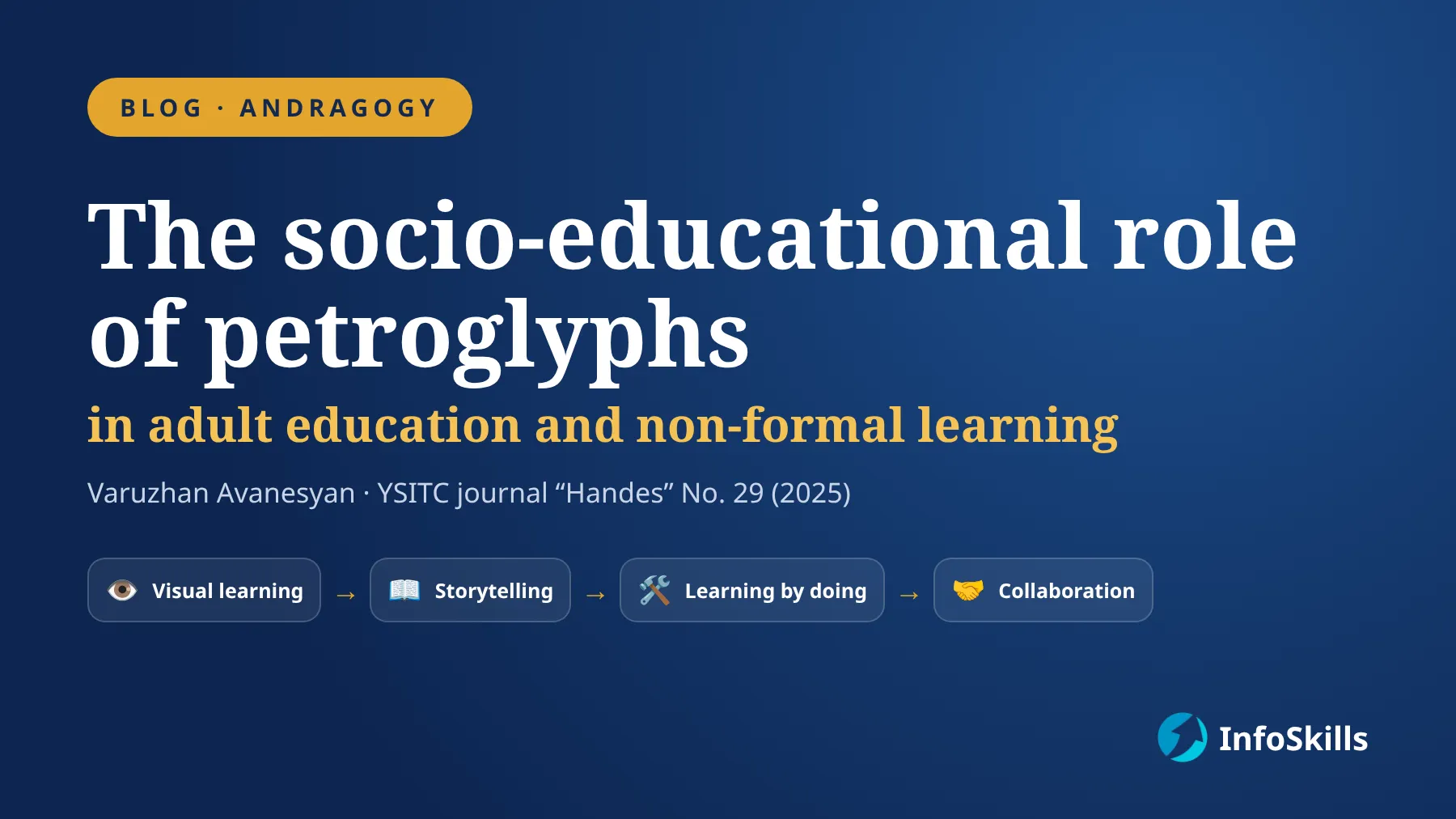
The socio-educational role of petroglyphs in the context of adult education and non-formal learning
How petroglyphs served as a system for encoding, preserving and passing on knowledge between generations, and what they share with modern andragogy, visual learning, storytelling and collaborative learning. The abstract of an article first published in the journal Handes of the Yerevan State Institute of Theatre and Cinema, No. 29 (2025); the full text is available in Armenian.

This article was first published in Armenian in the scholarly journal Handes of the Yerevan State Institute of Theatre and Cinema, No. 29 (2025). The full text is available in Armenian: read the article or download the PDF. DOI: 10.61939/29537959-2025.29-113
Varuzhan Avanesyan, Senior Lecturer, Chair of Art and Humanities, Yerevan State Institute of Theatre and Cinema
Abstract
This study examines petroglyphs as an early system of non-formal adult education and explores their parallels with the principles of contemporary andragogy. Petroglyphs in prehistoric societies served as instruments of knowledge encoding, preservation, and intergenerational transmission, while also shaping collective memory and social identity. The analysis highlights the didactic features of petroglyphs, including visual learning, symbolic language, narrative structures, learning by doing, and group-based knowledge transfer. These mechanisms demonstrate striking similarities with modern educational approaches such as visual methods, concept mapping, storytelling, project-based learning, and collaborative learning.
Special attention is given to the Armenian petroglyphs of the Geghama mountain range and Ughtasar, which reflect complex semiotic systems with multilayered semantic structures. These visual systems performed not only artistic but also educational, informational, and socializing functions within prehistoric communities.
The study concludes that petroglyphs can be considered a valuable model for enriching contemporary non-formal education practices, enhancing innovative approaches to knowledge management, and ensuring both didactic diversity and socio-cultural relevance.
Keywords: Petroglyphs, non-formal education, adult learning, knowledge management, visual learning, multimodal learning, scaffolding, situated learning.
The full article, with comparison tables of petroglyph teaching methods and modern approaches (visual learning, concept mapping, storytelling, project-based and collaborative learning) and examples from theatre education, is available in Armenian.
© 2026 InfoSkills, Varuzhan Avanesyan. Reuse only with the author's permission and a link to the source.










No comments yet. Be the first.